
Legal Declaration Regarding Death and Estate Matters
Letter
A handwritten French legal declaration written on stamped fiscal paper, reporting the death of an individual and addressing related legal or estate matters.
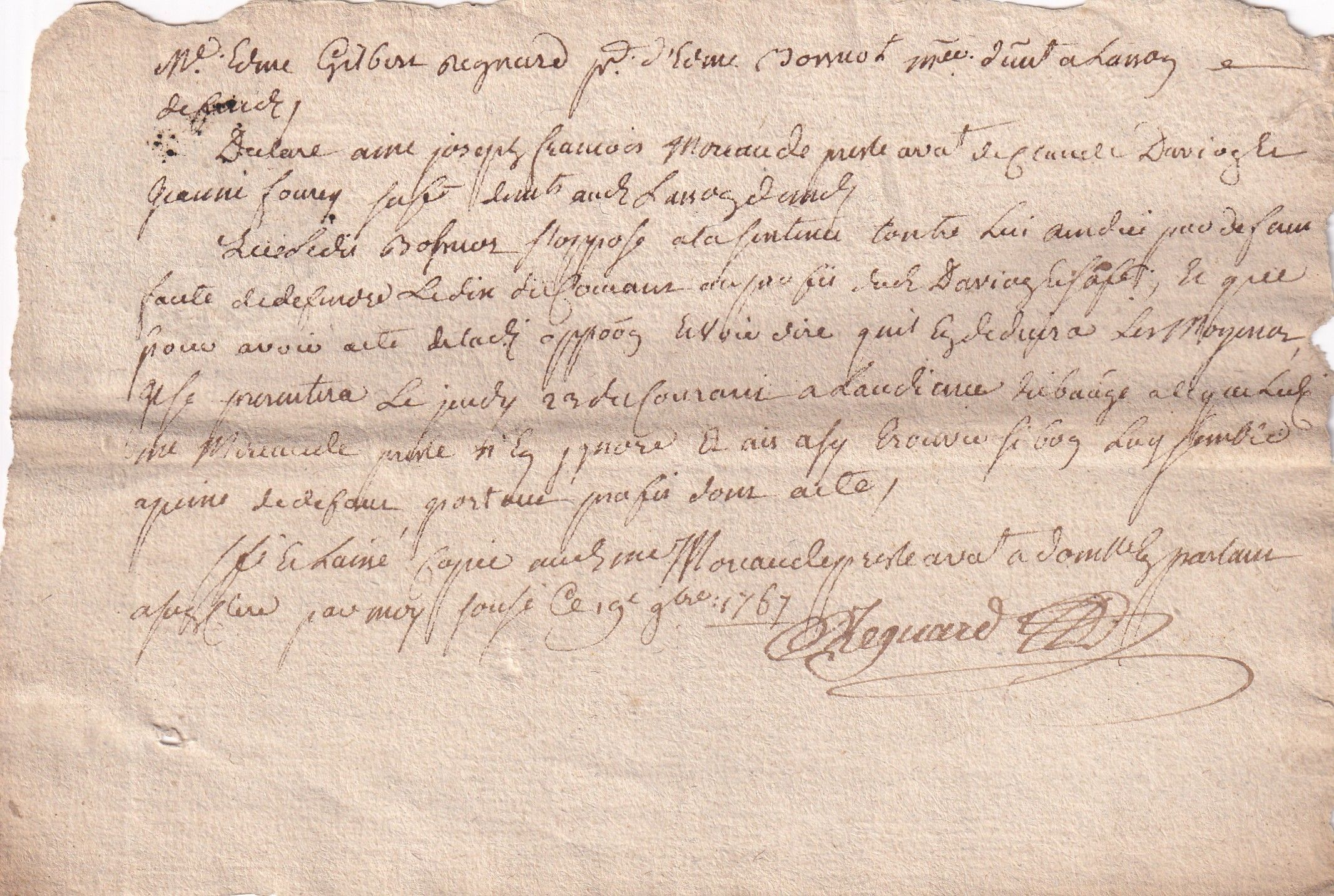

RE-LE-1767-0013
Official declaration concerning the death of an individual and associated legal or administrative responsibilities.
France
Business & Legal Documents
May 27, 1767
18th Century
Transcription (Partial – normalized spelling) Mᵉ Étienne Gilbert, écuyer… Déclare que Joseph François Moreau… est mort avant la présente… …le service fait… …ce vingt sept may 1767. Signé: Requard (Some portions remain unclear due to ink fading and script compression.) English Translation (Summary) Master Étienne Gilbert, squire, declares that Joseph François Moreau died prior to the present declaration. The statement is made for official record concerning the service rendered and related matters. Written on the twenty-seventh day of May, 1767. Signed: Requard.
French
his document reflects the bureaucratic culture of Ancien Régime France, where legal acts required the use of government-issued stamped paper to validate their authenticity and ensure tax revenue for the crown. Such declarations were often produced in connection with inheritance, estate settlement, military service, or administrative obligations. The use of formal titles such as écuyer (squire) indicates the presence of minor nobility or administrative officials. Documents of this type illustrate how death triggered a series of legal notifications and financial procedures within early modern society. Stamped fiscal paper was introduced as a method of regulating and taxing legal documentation, making surviving examples valuable artifacts of the administrative state.
Description
This manuscript legal declaration, written on officially stamped fiscal paper in 1767, records the death of an individual and serves as a formal statement within the administrative framework of eighteenth-century France. The document was drafted in cursive legal script typical of provincial clerks and validated through signature. Stamped paper bearing the fiscal mark “vingt centimes” indicates the document was produced within the regulated system of legal taxation established under the French monarchy. Such documents were necessary for estate administration, inheritance proceedings, and other official matters requiring written proof. The artifact exemplifies the expanding bureaucratic infrastructure of pre-Revolutionary France, where everyday legal events—from property transfers to death declarations—were carefully recorded and taxed by the state.