
Solicitor Letter Regarding Post Office Order and Financial Matters
Letter
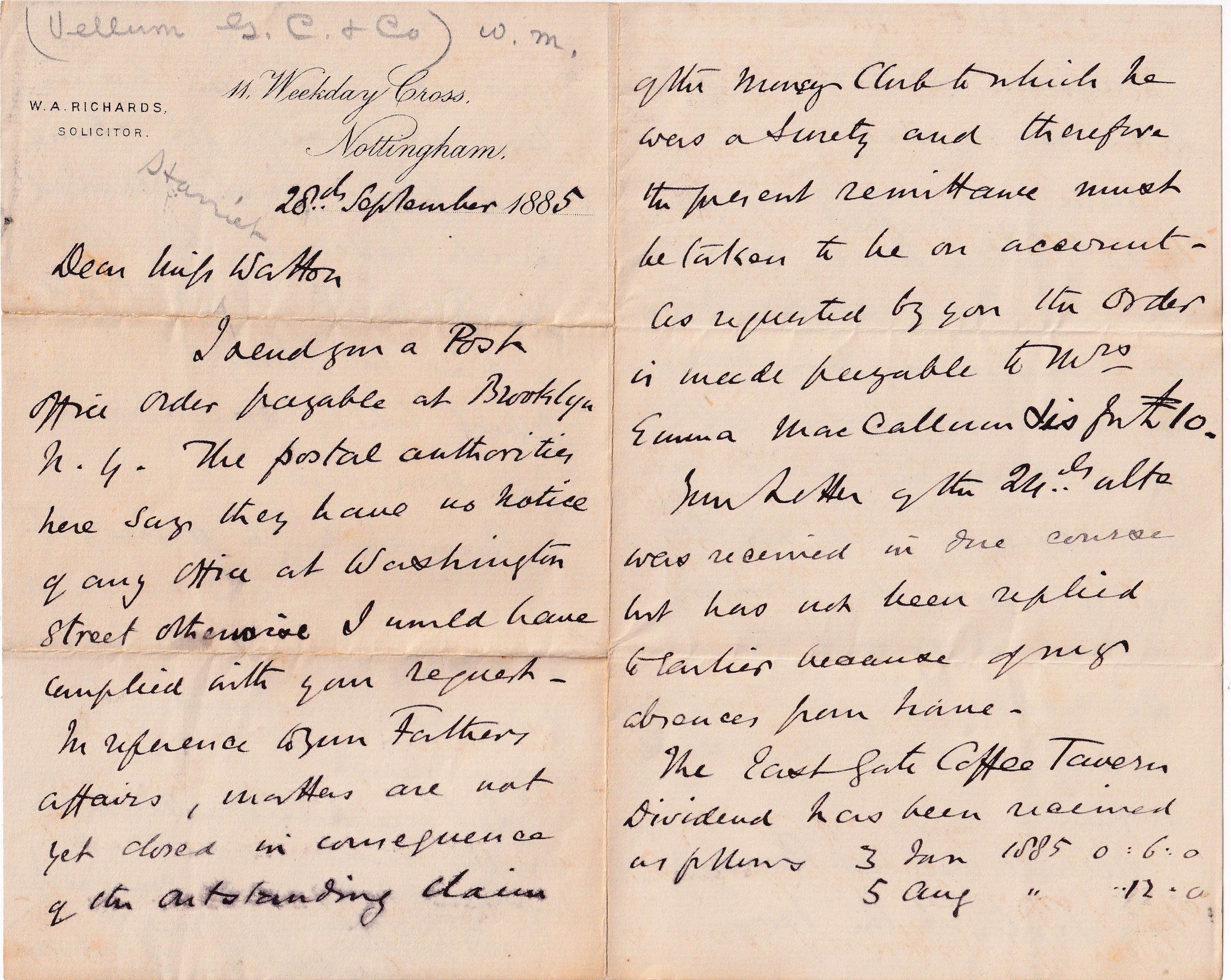
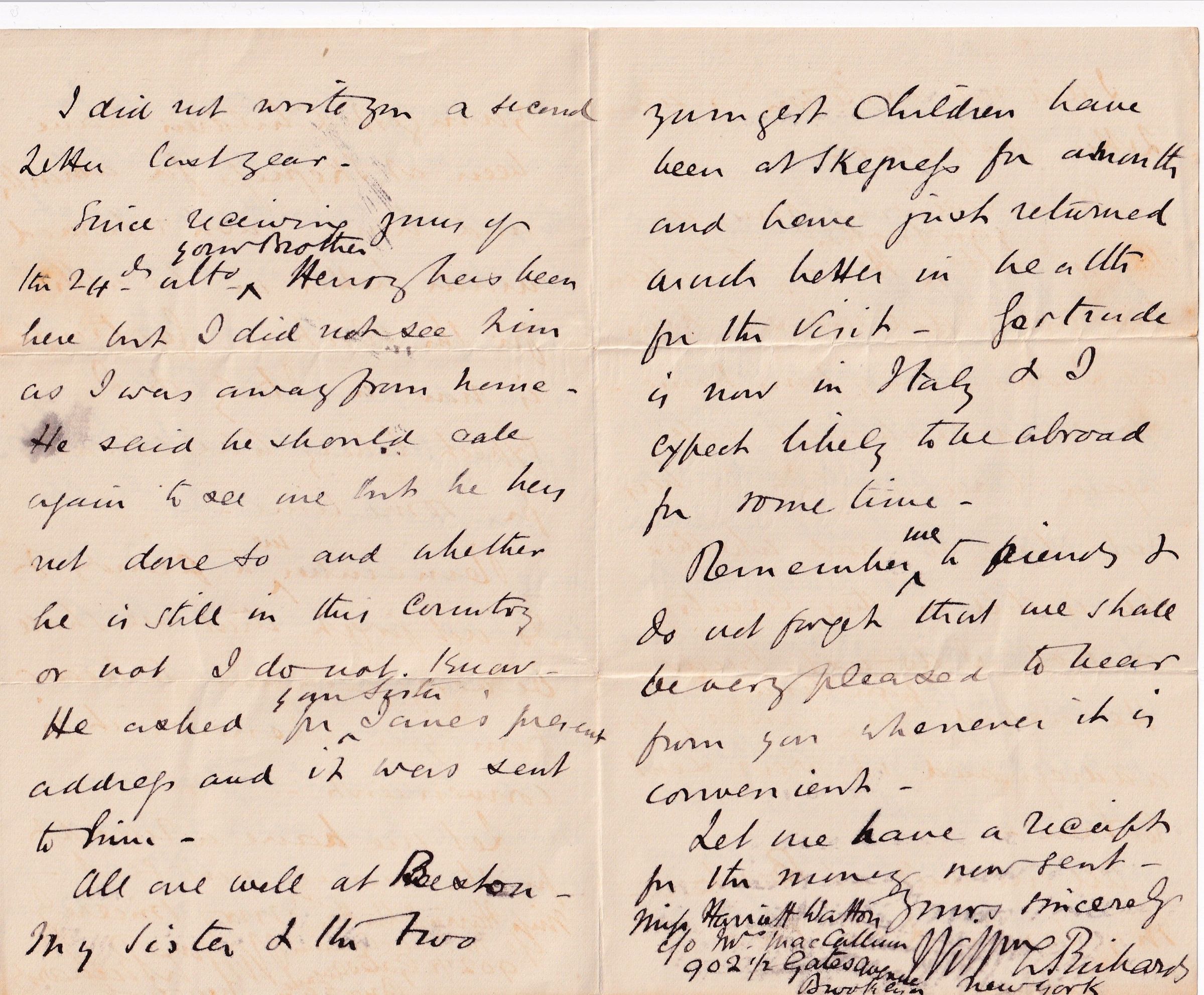
A handwritten solicitor’s letter dated September 28, 1885 from Nottingham, England discussing financial remittances, a Post Office Order payable in Brooklyn, and updates on family affairs.
RE-LE-1885-0029
Family and financial correspondence discussing remittance of funds, outstanding claims, and family news.
England
Business & Legal Documents
Personal Correspondence Letters
Sep 28, 1885
Victorian
W. A. Richards Solicitor 11 Weekday Cross Nottingham
Nottingham 28th September 1885 Dear Miss Walton, I send you a Post Office Order payable at Brooklyn N.Y. The postal authorities here say they have no notice of any office at Washington Street otherwise I would have complied with your request. In reference to your father’s affairs, matters are not yet closed in consequence of the outstanding claims which Messrs Clarke to which he owes a sum, and therefore the present remittance must be taken to be on account. As requested by you the order is made payable to Mrs Emma MacCallum and is for £10. Your letter of the 24th ultimo was received in due course but has not been replied to earlier because of my absence from home. The East Gate Coffee Tavern dividend has been received as follows: 3 June 1885 — 0 : 6 : 0 5 Aug — 0 : 12 : 0 I have not written you a second letter last year since receiving yours of the 24th. Also Henry has been here but I did not see him as I was away from home. He said he should call again to see me but he has not done so and whether he is still in this country or not I do not know. He called for you at Jane’s house and it was sent to him. All are well at Beeston. My sister and the two youngest children have been at Skegness for a month and have just returned much better in health for the visit. Gertrude is now in Italy and I expect likely to be abroad for some time. Do not forget that we shall be very pleased to hear from you whenever it is convenient. Let me have a receipt for the money now sent. Miss Harriet Walton c/o Mrs MacCallum 902½ Gates Avenue Brooklyn New York Yours sincerely W. A. Richards Modern English Explanation The solicitor W. A. Richards writes to Miss Harriet Walton in Brooklyn. The letter discusses: • Sending £10 via Post Office Order • Legal matters relating to her father’s estate • Outstanding claims against the estate • Investment dividends from the East Gate Coffee Tavern • Family news from Beeston, Nottinghamshire • Relatives traveling to Skegness and Italy He also requests a receipt confirming she received the money.
English
This letter reflects the financial and social networks of late Victorian middle-class families. Solicitors frequently acted as both legal advisors and financial intermediaries, particularly when estates, investments, or remittances were involved. The correspondence also demonstrates how international migration affected family communication. Even when relatives lived abroad, they remained financially connected through legal representatives and postal banking systems.
Historical Note
This letter illustrates Victorian international financial communication. Key details: Post Office Orders These were widely used to send money internationally before modern banking transfers. Coffee Taverns The Coffee Tavern movement was part of the Victorian temperance movement, promoting alcohol-free social spaces. Investors often purchased shares in these establishments. Transatlantic Family Networks Many British families had relatives living in the United States, particularly in cities like Brooklyn. Letters like this show how legal and financial matters were managed across the Atlantic. Written in Nottingham on September 28, 1885, this letter from solicitor W. A. Richards discusses financial matters concerning the estate of Harriet Walton’s father. The letter includes details about a £10 remittance sent via Post Office Order payable in Brooklyn, New York, as well as dividends from an investment in the East Gate Coffee Tavern. Such correspondence illustrates the legal and financial relationships that connected families across the Atlantic during the late nineteenth century. Solicitors often acted as intermediaries managing estates and investments for relatives who had emigrated to the United States.