
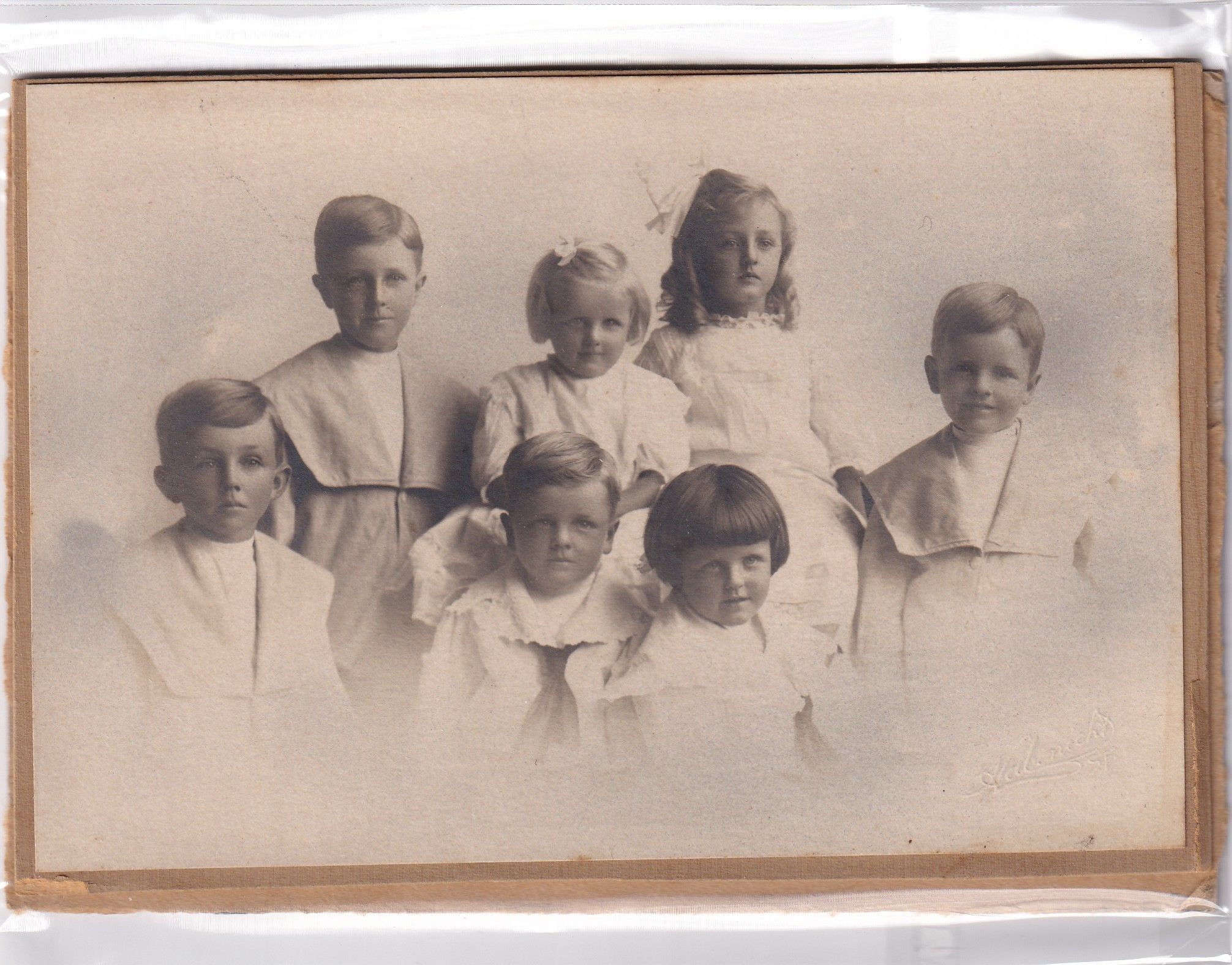
Group Portrait of Seven Children
Photograph
Sepia-toned photograph mounted on warm tan card stock with subtle embossed studio signature in the lower right corner. The image depicts seven children arranged in a tight grouping against a soft, light studio backdrop. The lower portion of the photograph features a gentle fade vignette, common in early 20th-century portraiture.
RE-PH-2026-0062
child
boy
girl
1900’s
Unknown
circa 1908 – circa 1915
Edwardian
Unknown
Embossed mark lower right (appears to read “Mc…”, possibly McClure or McCue; further magnification recommended) 👦 Boys’ Dress The boys wear: Wide, square sailor-style collars Light-colored tunic-style tops Short or knee-length garments (likely paired with stockings) The sailor collar remained popular for boys from the 1890s into the 1910s but the softer cut and simplified styling here suggest early 20th century rather than strict Victorian era. Hair: Smooth side parts Short, tidy cuts No long ringlets or lace embellishment (more common pre-1900) 👧 Girls’ Dress The girls wear: White dresses with ruffled or lace trim Modest bows in hair Softly waved shoulder-length hair Notably, the front right child’s blunt bob haircut is particularly telling — this style becomes more common after 1905 and especially into the 1910s.
This is almost certainly a sibling group portrait. Seven children in one photograph suggests: A large family Possibly a commemorative portrait (holiday, milestone, father absent, etc.) Likely middle-class household given coordinated clothing and professional studio session The consistent light garments and sailor motifs reflect early 20th-century ideals of: Childhood innocence Cleanliness and uniformity Modern upbringing The fade vignette around the lower portion gives the image a slightly ethereal quality typical of early 1900s portrait studios.
Very Good
Feb 14, 2026
Light edge wear Minor mount abrasion Gentle surface toning No major emulsion damage visible
Description
This early twentieth-century studio portrait presents seven children arranged in a carefully balanced grouping, dressed in sailor-collared tunics and white dresses characteristic of Edwardian childhood fashion. The coordinated attire and soft vignette aesthetic reflect evolving ideals of innocence, modern family life, and middle-class identity in the years just before World War I.