
Notarial Act of Property and Seigneurial Obligations — Parish Land Holdings
Letter
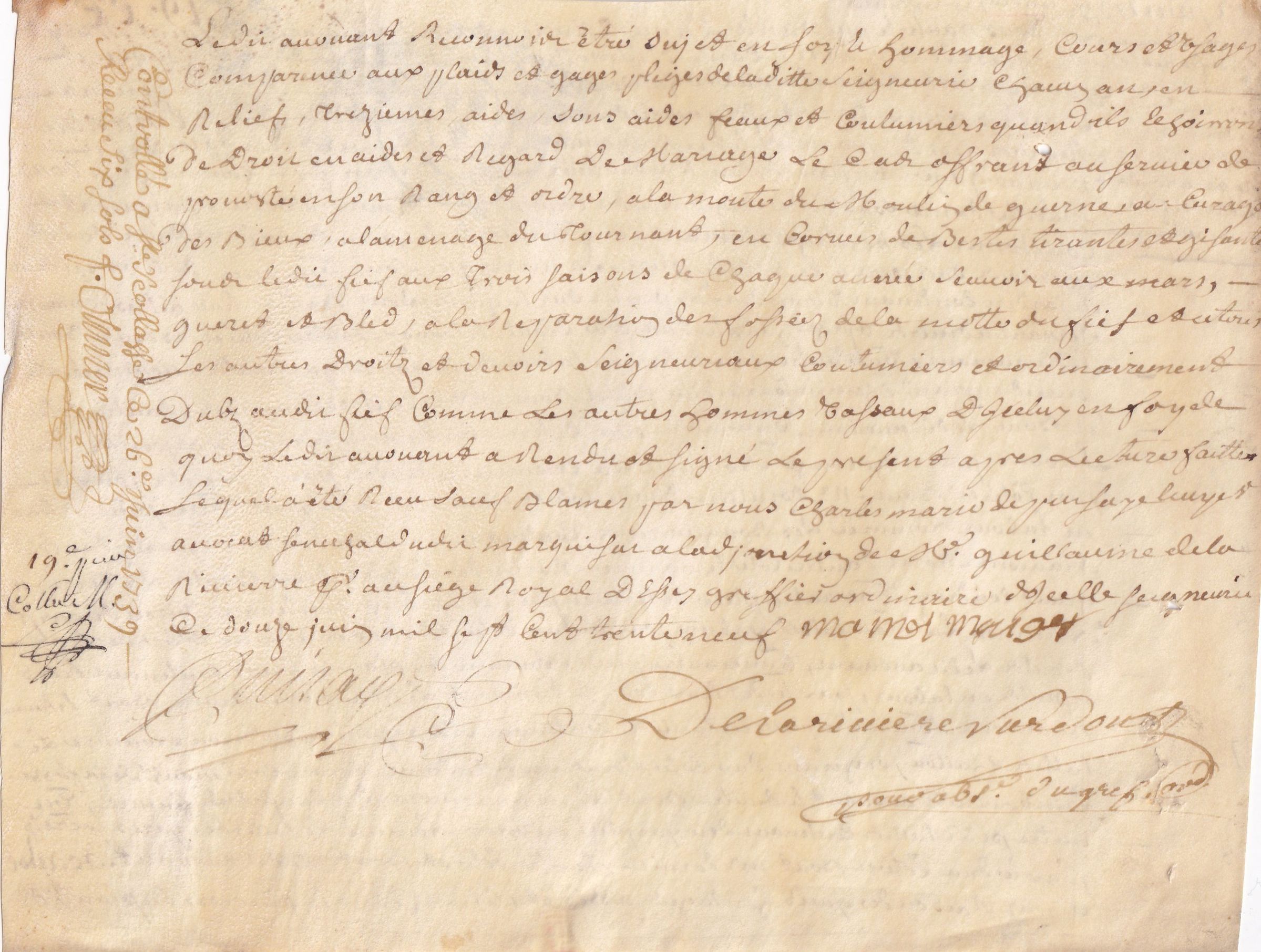
An official French notarial record detailing inherited agricultural lands, property boundaries, and feudal obligations owed to a local seigneur. The document records parcels of farmland, meadows, and cultivated plots, including descriptions of neighboring lands and tenure responsibilities.

RE-LE-1739-0010
Land inheritance, property tenure, and feudal obligations
France
Business & Legal Documents
Jun 12, 1739
18th Century
Transcription (Partial — key readable portions) “Le douzième juin mil sept cent trente neuf… comparurent aux plaids et gages… héritages assis et situés dans la paroisse… terres labourables, prés et jardins… tenus en fief et sujets aux droits seigneuriaux…” English Translation (Summary of Content) “On the twelfth of June, one thousand seven hundred thirty-nine, the parties appeared before the court… concerning inherited properties located in the parish… consisting of arable lands, meadows, and gardens… held in fief and subject to seigneurial dues and obligations…” The document itemizes: • Multiple agricultural parcels • Acreage measurements • Neighboring property owners • Seigneurial taxes and labor obligations • Formal witnessing and legal validation
French
This document reflects the feudal landholding structure of pre-Revolutionary France, where peasants and minor landholders operated farms under obligations to a local seigneur. Such acts were essential for inheritance, land transfers, and taxation records. The careful boundary descriptions show the importance of agricultural productivity and communal land management. The document illustrates how rural families maintained multi-generational holdings within rigid legal hierarchies.
Description
This manuscript notarial act provides a detailed record of rural land tenure in 18th-century France. Drafted in formal legal script, it documents inherited agricultural holdings including fields, meadows, and cultivated plots situated within a parish governed by seigneurial authority. The act carefully records acreage, boundaries, and neighboring proprietors, demonstrating the meticulous land administration typical of ancien régime France. Beyond property description, the document outlines feudal obligations — including dues, labor services, and legal responsibilities owed to the seigneur — offering insight into the economic structure that shaped everyday rural life. Such records were foundational to inheritance law, taxation systems, and agrarian stability. The manuscript stands as an example of the bureaucratic precision of French notarial culture prior to the Revolution, when land, lineage, and legal duty were deeply intertwined.