
Medical Testimonial for Nurse Walton Regarding Treatment of Typhoid Fever
Letter
A handwritten medical testimonial dated June 10, 1872 from Tavistock, Devon, written by a physician praising the nursing care provided by Nurse Walton during a severe case of typhoid fever.
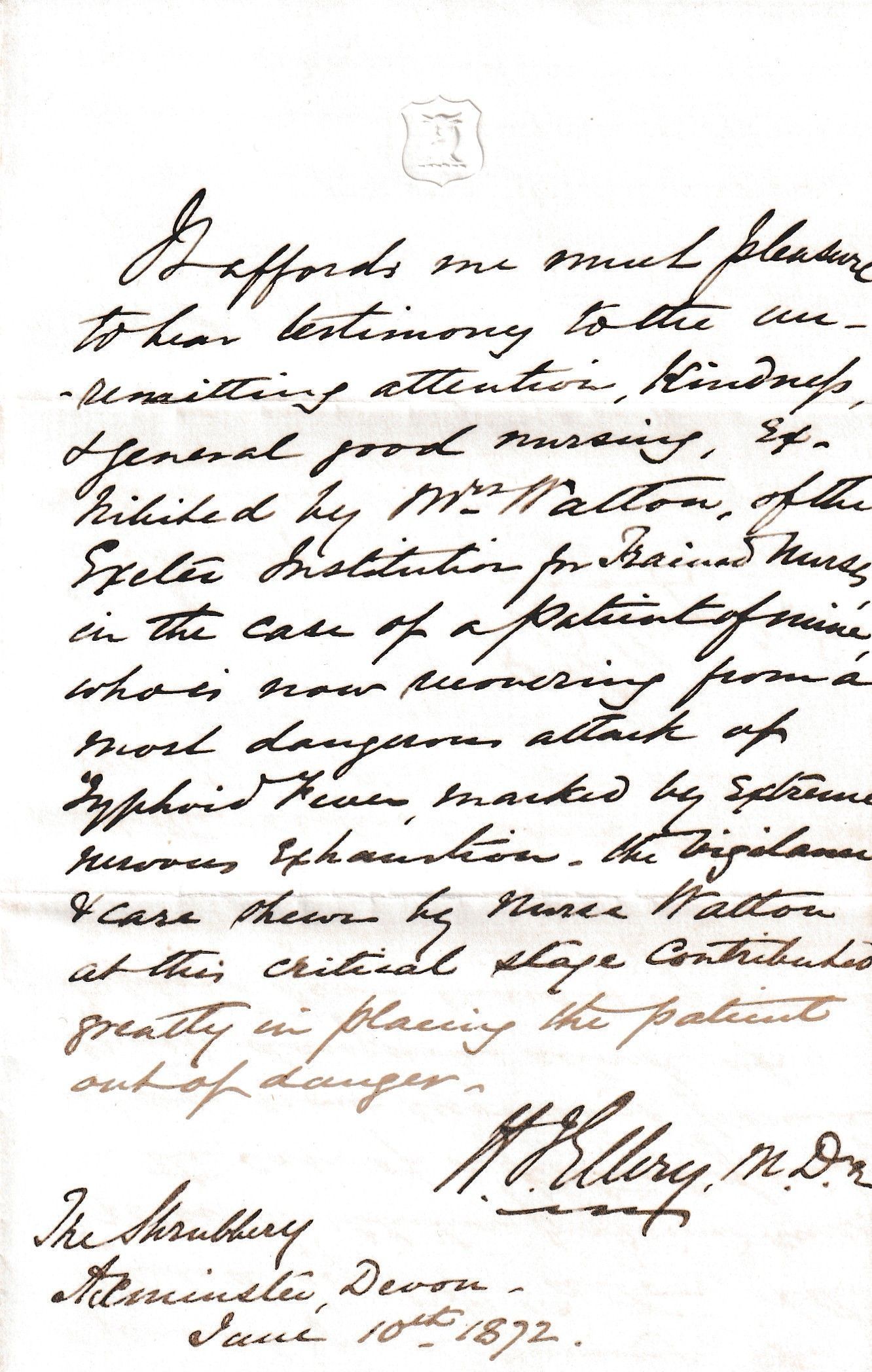
RE-LE-1872-0027
Professional testimonial acknowledging skilled nursing care in a severe typhoid fever case.
England
Letters of Recommendation
Jun 10, 1872
Victorian
Address listed: The Shrubbery Tavistock, Devon
It affords me much pleasure to bear testimony to the unremitting attention, kindness, general good nursing, etc. exhibited by Mrs. Walton of the Exelia Institution for Trained Nurses in the case of a patient of mine who is now recovering from a most dangerous attack of Typhoid Fever, marked by extreme nervous exhaustion. The vigilance and care shown by Nurse Walton at this critical stage contributed greatly in placing the patient out of danger. H. J. Ellery, M.D. The Shrubbery Tavistock, Devon June 10th, 1872
Historical Note
Typhoid fever was one of the most deadly infectious diseases of the 19th century, caused by contaminated water and poor sanitation. Before antibiotics (which were not developed until the 20th century): • Mortality rates could reach 10–30% • Careful nursing was often the only life-saving treatment • Hydration, cooling fever, and monitoring complications were critical During the Victorian period, the professionalization of nursing expanded rapidly following the influence of Florence Nightingale and the establishment of trained nursing institutions. Documents like this were commonly issued to nurses to help them obtain employment or positions in hospitals or private care. This document reflects the professionalization of nursing during the Victorian era. As formal training institutions for nurses emerged in the decades after Florence Nightingale’s reforms, written testimonials from physicians became an important form of credential. Such endorsements served as references confirming a nurse’s competence, reliability, and compassion. The emphasis on “unremitting attention,” kindness, and vigilance highlights the Victorian ideal of nursing as both a technical and moral vocation. These certificates were often carried by nurses as proof of skill when seeking new employment.