
Advisory Letter to George on Household Management and Family Matters
Letter
A detailed personal letter written to “George” in January 1897, offering advice on managing a household, furnishing a home, and sharing extensive family news, reflections, and emotional sentiments.
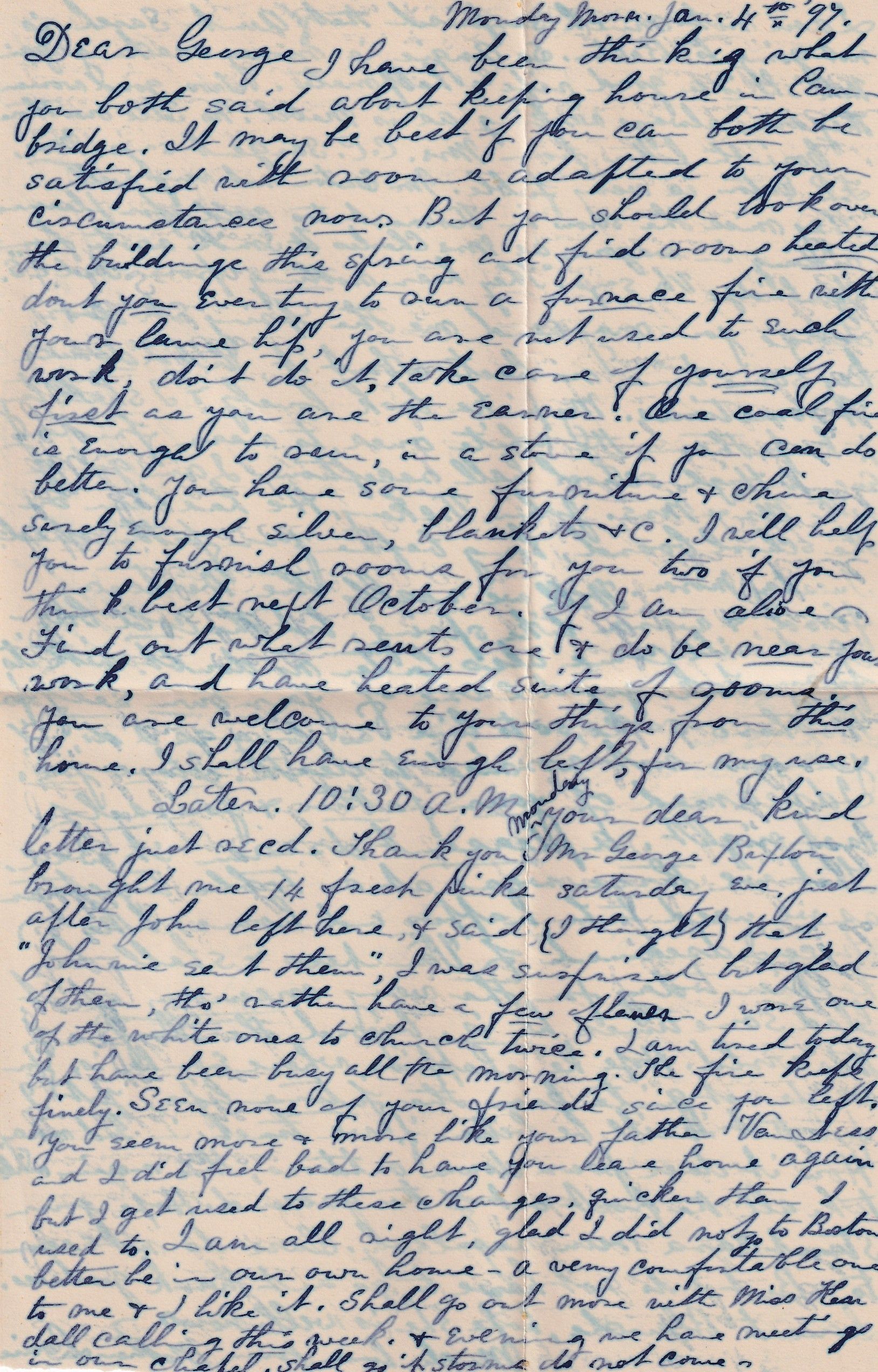
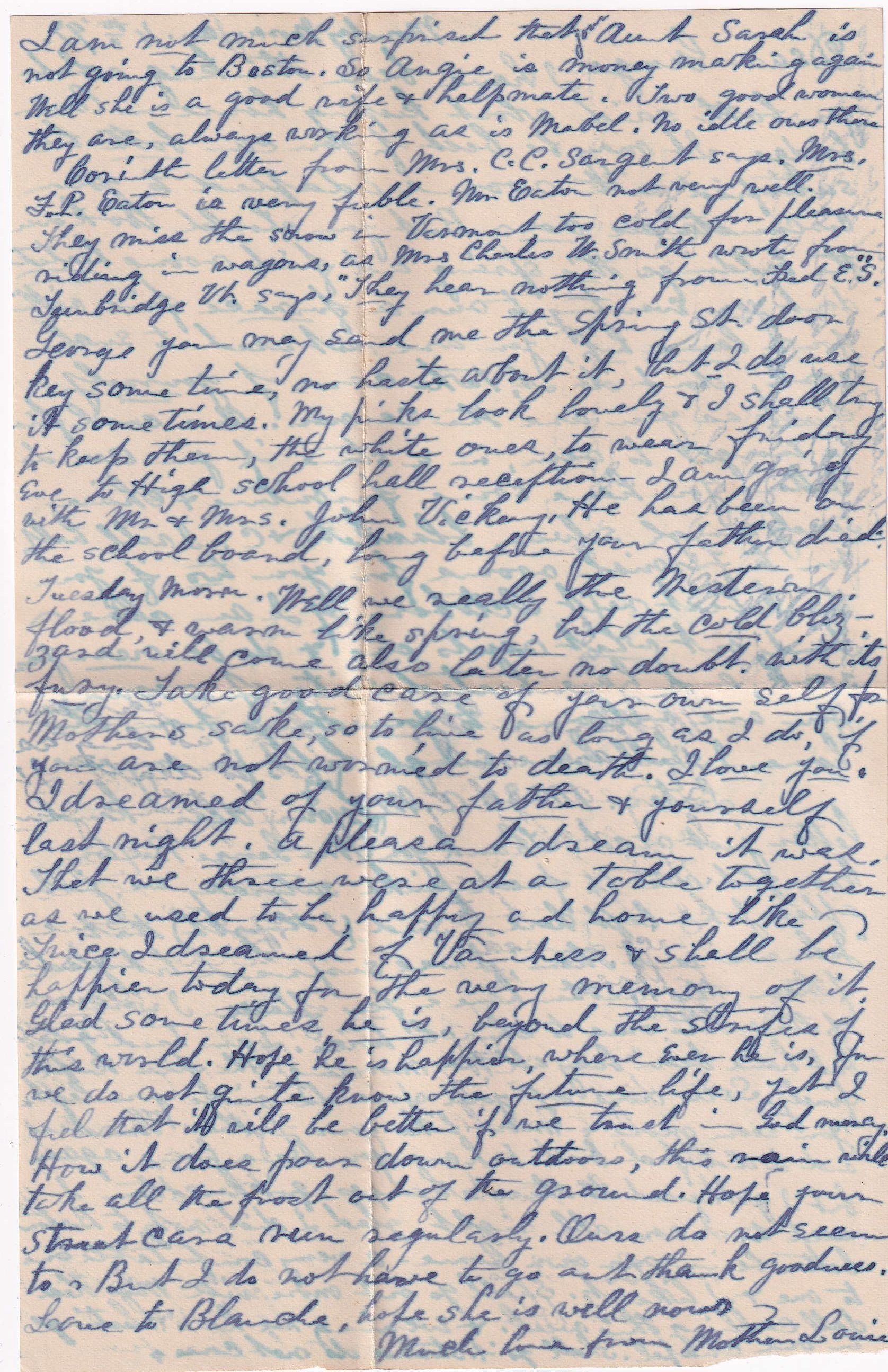
RE-LE-1897-0049
Family advice, domestic management, and personal reflections
United States
Personal Correspondence Letters
Jan 4, 1897
Victorian
Dear George, I have been thinking what you both said about keeping house in Cambridge. It may be best if you can both be satisfied with rooms adapted to your circumstances now, but you should look over the building this spring and find rooms heated. Do not you ever try to run a furnace fire with your lame hip, you are not used to such work. Do not do it. Take care of yourself first, as you are the earner. One coal fire is enough to run, or a stove, if you can do better. You have some furniture and china already, and silver, blankets, etc. I will help you to furnish rooms for you two if you think best next October. If I am able, find out what rents are and do not be mean for work, and have heated suites of rooms. You are welcome to your things from this home. I shall have enough left for my wants. Later, 10:30 A.M. Your letter just arrived. Thank you. Mr. George Brigham brought me the fresh fruit Saturday evening just after John left here. He said, “It was just like Johnnie sent them.” I was surprised but glad of them also, as they came a few days ago. I wore one of the white ones to church twice. I am tired today but have been busy all the morning. The fire kept finely. Seen none of your friends since you left. You seem more and more like your father. I was sad to have you leave home again, but I get used to these changes quicker than I used to. I am all right, glad I did not go to Boston. Better be in our own home — a very comfortable one to me and I like it. Shall go out more with Miss H. calling this week, and evenings we have meetings in our chapel, if it storms do not come. I am not much surprised that Aunt Sarah is not going to Boston. So Angie is money-making again. Well, she is a good wife and helpmate. Two good women they are, always working, as is Mabel. No idle ones there. I do not think the letter from Mrs. C. C. Sargent says Mrs. F. P. Eaton is very feeble. Mr. Eaton not very well. They miss the snow in Vermont — too cold for pleasure riding in wagons, as Mrs. Charles W. Smith wrote from East S. Cambridge, Vt., says “They hear nothing from E.S.” George, you may send me the spring silk dress key sometime. I am not hasty about it, but I do need it sometimes. My petticoats look lovely and I shall try to keep them. The white ones I wear Fridays. I am going to the High School hall reception this evening with Mr. & Mrs. John Vickers. He has been on the school board a long time. Your father died Tuesday morn. Well, we really have the Western flood. It seems like spring, but the cold blizzards will come also later, no doubt, with icy frosts. Take good care of your own self, for Mother’s sake, so to live as long as I do. You are not wanted to death. I dreamed of your father and yourself last night. A pleasant dream it was. That we three were at a table together as we used to be, happy at home, like twice I dreamed of Van Hees, and shall be happier today for the memory of it. Good sometimes he is beyond the suffering of this world. Hope he is happy where now he is, for we do not quite know the future life, yet I feel that it will be better if we trust. How it does pour down outdoors, this rain will take all the frost out of the ground. Hope your Stomach can run regularly. Yours do not seem to. But I do not have to go out — thank goodness. Love to Blanche, hope she is well now. Much love from Mother Louie
English
This letter offers a rich view into late Victorian domestic life and family dynamics. It reflects expectations placed on men as providers (“you are the earner”) and the practical realities of setting up a household. The writer emphasizes thrift balanced with comfort, proper domestic management, and concern for health. The letter also highlights strong familial bonds, extended kin networks, and regular communication as a central social practice. References to church, social calls, and community events illustrate the importance of local social life and moral structure.
Historical Note
Dated 1897, this letter falls within a period of industrial maturity in the United States, when urban living (such as Cambridge and Boston) was becoming more common among middle-class families. The mention of heated rooms, furnaces, and rented suites reflects technological and social changes in housing. References to regional weather, including floods and blizzards, align with known climatic variability of the late 19th century. The letter also reflects the transition from rural to more urbanized lifestyles.