
Encouraging a Niece Entering the Medical Profession
Letter
A handwritten Victorian family letter dated 15 June 1864 from Nottingham, England, in which an uncle encourages his niece in her pursuit of a medical career and expresses pride in her dedication to helping the sick.
RE-LE-1861-0026
Family correspondence discussing education, the medical profession, and family news.
England
Personal Correspondence Letters
Jun 15, 1864
Victorian
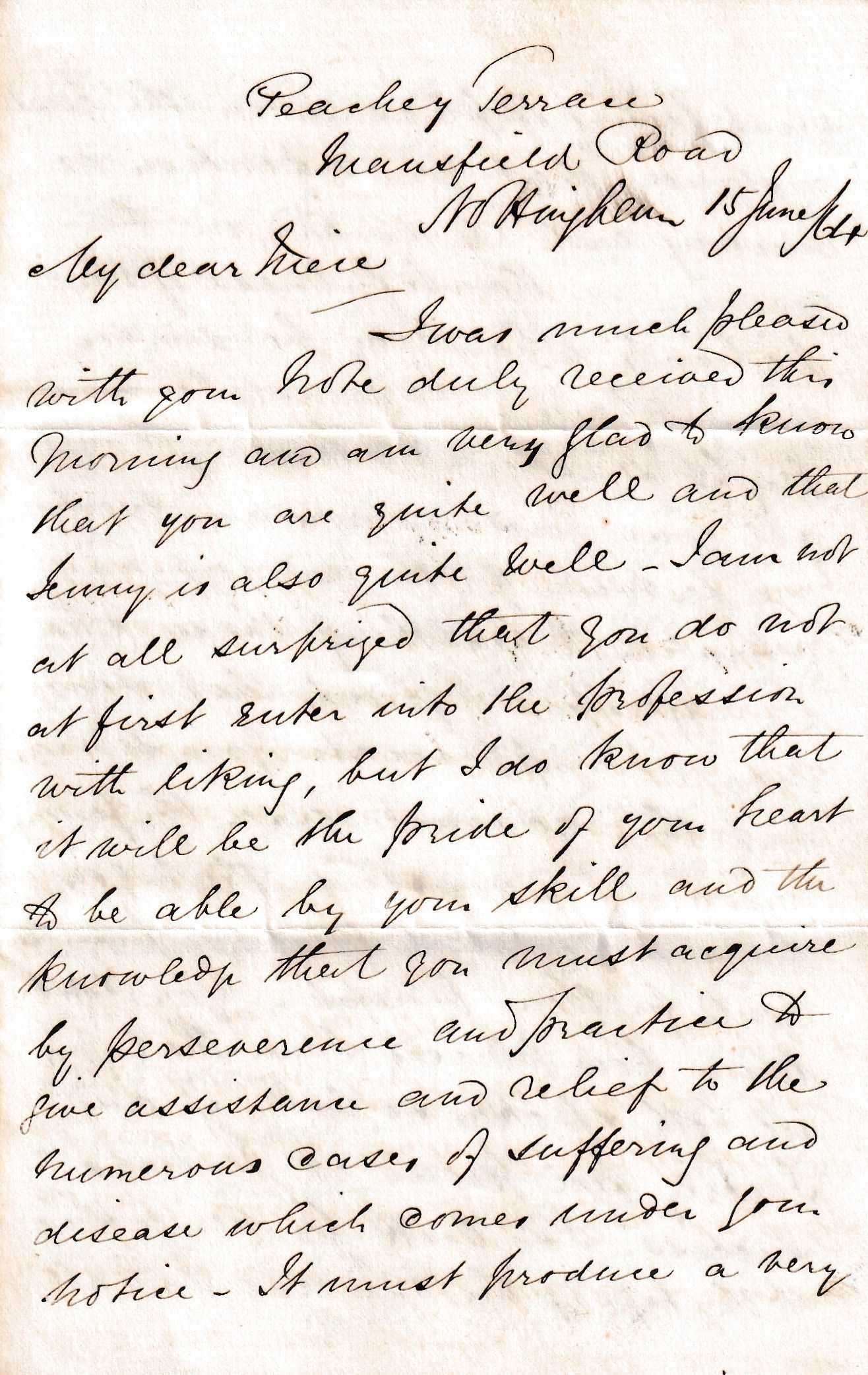
Peachey Terrace Mansfield Road Nottingham 15 June 1864
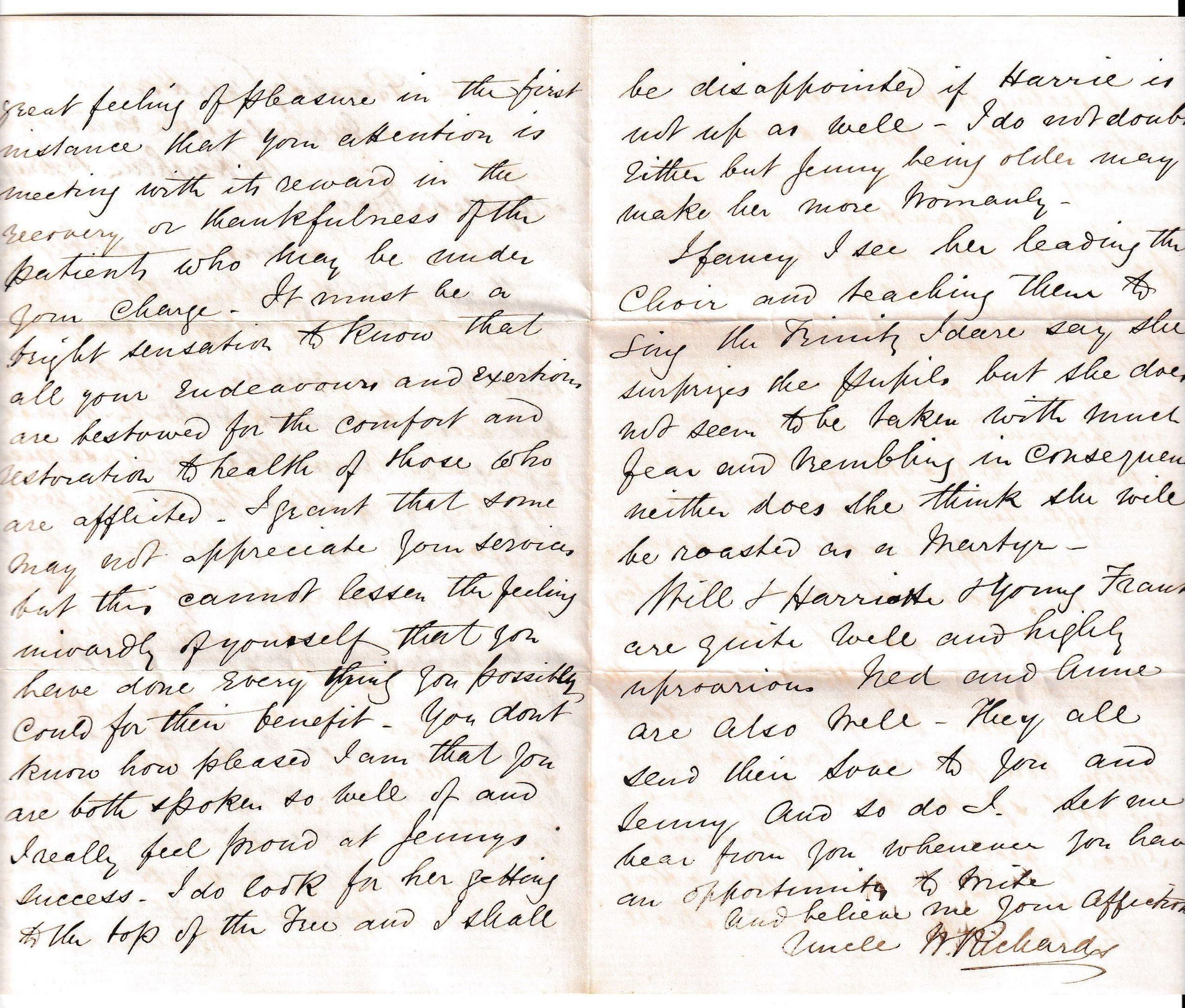
Peachey Terrace Mansfield Road Nottingham 15 June 1864 My dear Niece, I was much pleased with your note duly received this morning and am very glad to know that you are quite well and that Jenny is also quite well. I am not at all surprised that you do not at first enter into the profession with liking, but I do know that it will be the pride of your heart to be able by your skill and the knowledge that you must acquire by perseverance and practice to give assistance and relief to the numerous cases of suffering and disease which come under your notice. It must produce a very great feeling of pleasure in the first instance that your attention is meeting with its reward in the recovery or thankfulness of the patients who may be under your charge. It must be a bright sensation to know that all your endeavours and exertions are bestowed for the comfort and restoration to health of those who are afflicted. I grant that some may not appreciate your services, but this cannot lessen the feeling inwardly of yourself that you have done everything you possibly could for their benefit. You don’t know how pleased I am that you are both spoken so well of and I really feel proud at Jenny’s success. I do look for her getting to the top of the tree and I shall be disappointed if Harriet is not up as well. I do not doubt either but Jenny being older may make her more womanly. I fancy I see her leading the choir and teaching them to sing the French solfège. Some say she surprises the pupils but she does not seem to be taken with much fear and trembling in consequence neither does she think she will be roasted as a martyr. Will and Harriet and young Henry are quite well and highly uproarious. Ned and James are also well. They all send their love to you and Jenny and so do I. Let me hear from you whenever you have an opportunity to write and believe me, Your affectionate Uncle W. Richards Modern English Translation My dear niece, I was very pleased to receive your letter this morning and I am glad to hear that you are well, and that Jenny is also well. I am not surprised that you do not immediately enjoy entering the profession, but I know that it will become a source of pride for you. With skill, perseverance, and practice you will gain the knowledge necessary to provide help and relief to many people suffering from illness. It must bring great satisfaction when you see that your efforts result in patients recovering or expressing gratitude. It is a wonderful feeling to know that your work is helping restore health and comfort to those who are suffering. Some people may not appreciate what you do, but that should not diminish the knowledge within yourself that you have done everything possible to help them. I am very pleased to hear that both of you are spoken of so well, and I truly feel proud of Jenny’s success. I expect that she will rise to the very top, and I would be disappointed if Harriet does not do equally well. Jenny being older may help her become more mature. I imagine her leading the choir and teaching them to sing using French solfège. Some say she surprises her pupils, but she does not seem frightened by it, nor does she act as though she expects to be martyred for it. Will, Harriet, and young Henry are quite well and very lively. Ned and James are also well. They all send their love to you and Jenny, and so do I. Please write whenever you have the opportunity. Your affectionate uncle, W. Richards
This letter reflects the social and intellectual environment of the Victorian middle class in mid-19th-century England. The writer expresses pride in his niece’s entry into a professional field, likely medicine or nursing, which was still relatively uncommon for women during the 1860s. The letter emphasizes perseverance, education, and the moral duty of relieving suffering. The mention of teaching music and French solfège suggests a household that valued both education and cultural accomplishment, typical of respectable Victorian families. Family correspondence such as this provides insight into attitudes toward women’s professional roles during a period when opportunities for women were beginning to expand but remained socially contested.
Description
This Victorian family letter written in Nottingham on 15 June 1864 reflects the educational and professional aspirations of women during the mid-nineteenth century. In the letter, W. Richards writes to his niece to express pride in her dedication to a professional career that involves caring for the sick. He encourages perseverance and highlights the moral satisfaction derived from helping those suffering from illness. The letter also provides glimpses into family life, mentioning relatives and musical education. Documents such as this illustrate the growing acceptance—though still novel—of women entering professional and intellectual spheres during the Victorian era.