
Family Letter Discussing Post Office Orders and Family News
Letter
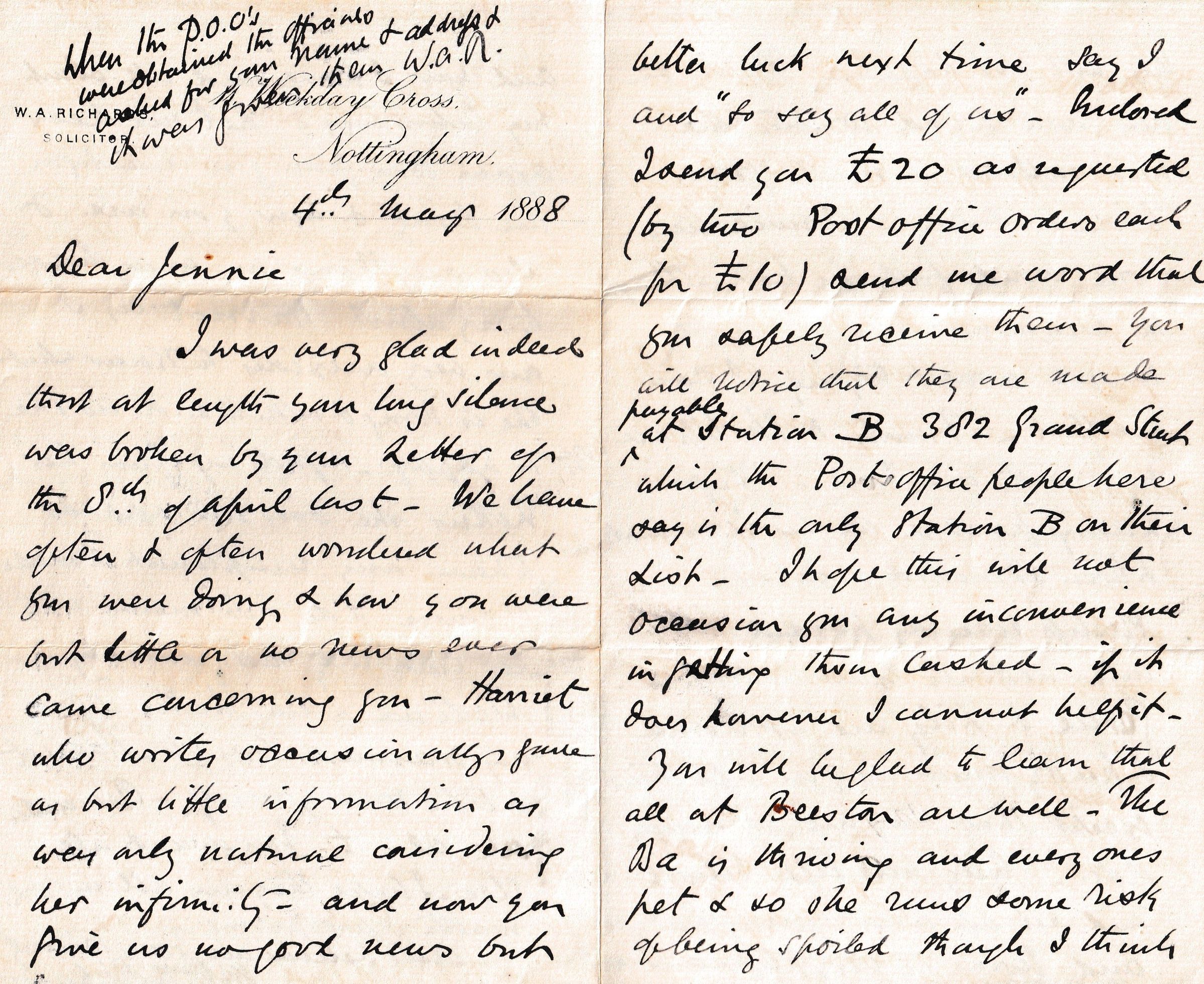
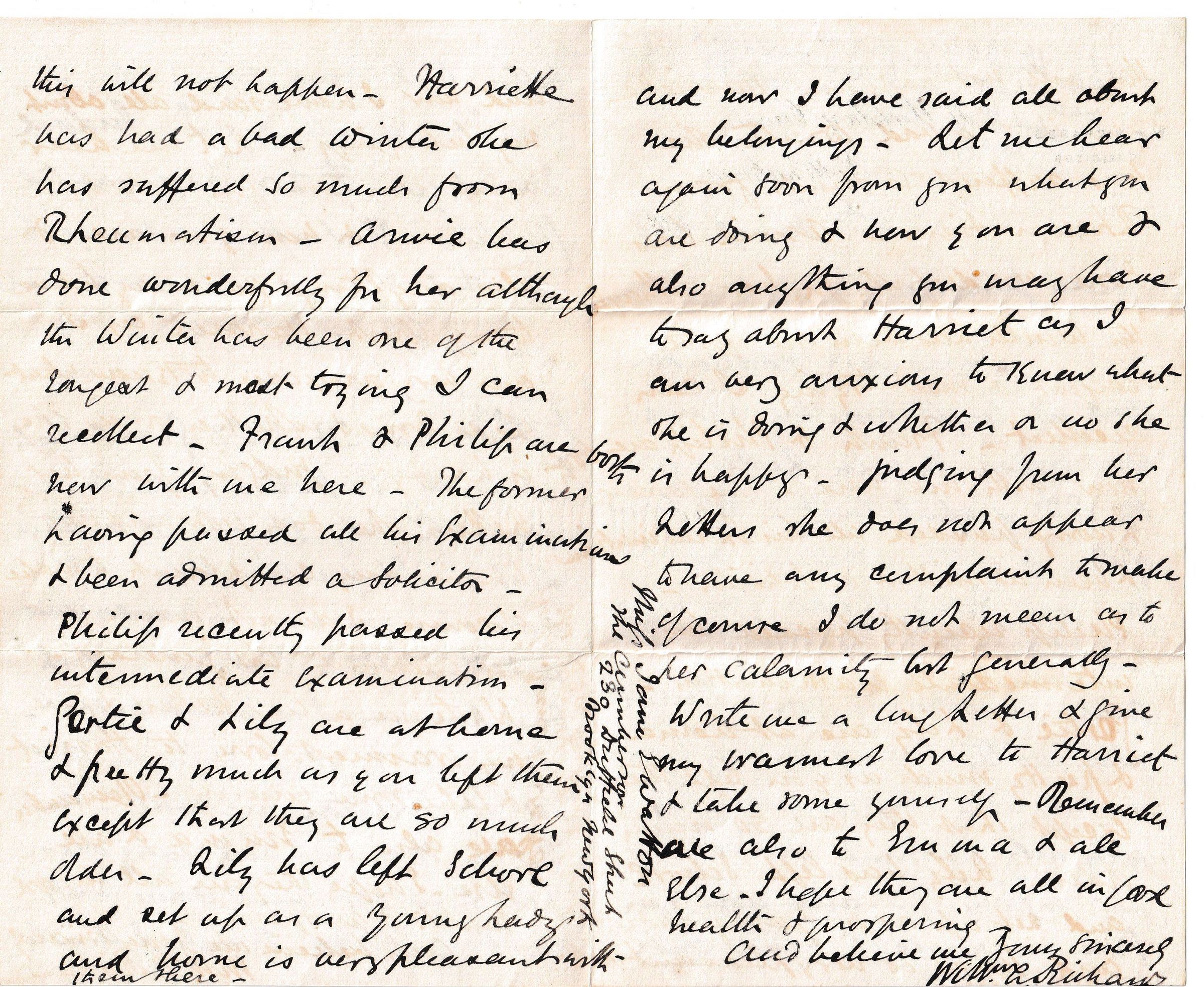
A handwritten family letter dated May 4, 1888 from Nottingham, England discussing family health, legal examinations, and the sending of money through Post Office Orders.
RE-LE-1888-0028
Family correspondence containing personal news, financial arrangements through the postal system, and updates on relatives and legal careers.
England
Personal Correspondence Letters
May 4, 1888
Victorian
Weekday Cross Nottingham
Nottingham 4th May 1888 Dear Jennie, I was very glad indeed that at length your long silence was broken by your letter of the 8th of April last. We have often and often wondered what you were doing and how you were, but little or no news ever came concerning you. Harriet who writes occasionally gave us as little information as was only natural considering her infirmity — and now you give us no good news but “better luck next time” says I, and “to try all of us.” Enclosed I send £20 as requested (by two Post Office Orders each for £10) send me word that you safely receive them. You will notice that they are made payable at Station B 302 Grand Street which the Post Office people here say is the only Station B on their list. I hope this will not occasion you any inconvenience in getting them cashed. If it does however I cannot help it. You will be glad to learn that all at Beeston are well. The old Pa is thriving and everyone is in good heart and no one seems likely of being “spooled,” though I think this will not happen. Harriette has had a bad winter. She has suffered so much from rheumatism. Annie has done wonderfully for her although the winter has been one of the longest and most trying I can recollect. Frank and Philip are both here with me. The former having passed all his examinations and been admitted a solicitor. Philip recently passed his intermediate examination. Pottie and Lily are at home and pretty much as you left them except that they are so much older. Alf has left school and set up as a Bunny boy and home is very pleasant with him here. And now I have said all about my belongings. Let me hear again from you when you are doing and how you are. I also anxiously want to know about Harriet as I am very anxious to know what she is doing and whether or no she is happy. Judging from her letters she does not appear to have any complaints to make. Of course I do not mean as to her calamity but generally. Write me a long letter and give my warmest love to Harriet and take some yourself. Remember me also to Emma and all else. I hope they are all in fair health and prosperity. And believe me, Yours sincerely W. A. Richards Modern English Explanation The writer: • Is relieved to finally receive a letter after a long silence • Sends £20 via Post Office Orders (a common Victorian financial method) • Gives updates on extended family members • Mentions relatives studying law and becoming solicitors • Describes illness (rheumatism) affecting Harriet • Encourages Jennie to write again and send news The letter reflects middle-class Victorian professional family life.
This letter illustrates the close ties of extended Victorian families who often lived across different towns or even countries. Communication relied heavily on letters, and financial support was frequently sent using postal money orders. The discussion of legal examinations and admission as a solicitor reflects the increasing importance of professional education during the late nineteenth century. The document also reveals the social expectation of maintaining regular correspondence and concern for relatives’ health and wellbeing. Such letters served as both personal communication and a record of family developments.
Description
Written in Nottingham on May 4, 1888, this family letter from solicitor W. A. Richards to a relative named Jennie provides insight into the daily concerns of a Victorian middle-class family. The letter includes updates on family health, educational achievements, and professional progress, particularly the admission of a family member as a solicitor. Richards also mentions sending £20 via Post Office Orders, illustrating the role of the British postal system as a secure means of transferring money during the late nineteenth century. Such correspondence reflects the social and financial networks that connected families during the Victorian era.