
Letter Concerning Retrieval of Property or Funds
Letter
A polite French personal letter requesting the prompt retrieval of an item or funds, written in formal courteous language typical of early 19th-century correspondence.
RE-LE-1815-0012
Personal correspondence regarding financial or material arrangements
France
Personal Correspondence Letters
Mar 16, 1815
19th Century
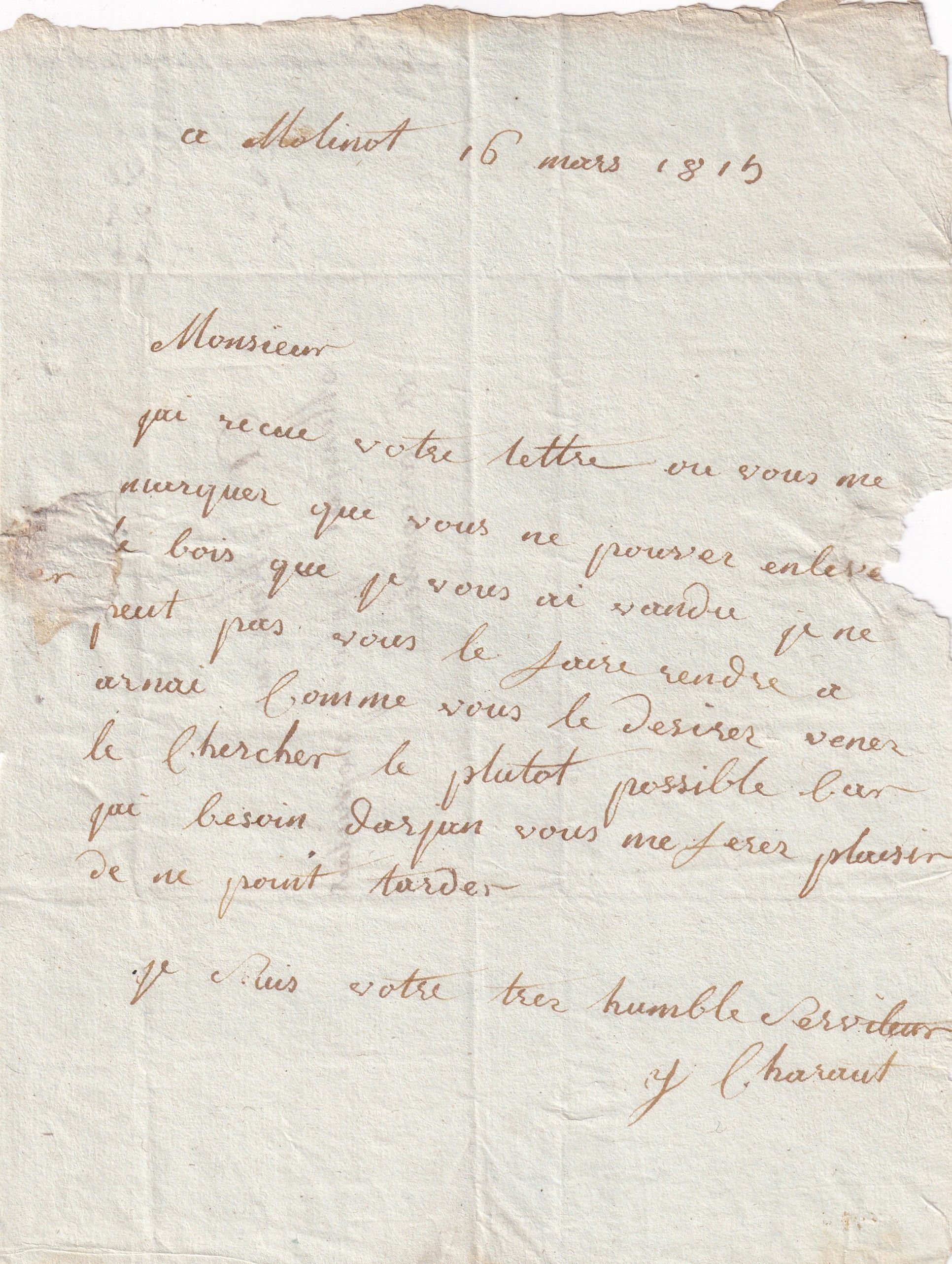
Transcription (Cleaned) A Molinet, le 16 mars 1815 Monsieur J’ai reçu votre lettre où vous me marquez que vous ne pouvez enlever le bois que je vous ai vendu. Je ne puis pas vous le faire rendre à moins comme vous le désirez venir le chercher le plutôt possible car j’ai besoin d’argent. Vous me ferez plaisir de ne point tarder. Je suis votre très humble serviteur J. Charaut English Translation Molinet, March 16, 1815 Sir, I have received your letter in which you inform me that you are unable to remove the wood that I sold to you. I cannot have it delivered to you unless, as you wish, you come to collect it as soon as possible, for I am in need of money. You would oblige me greatly by not delaying. I remain your very humble servant, J. Charaut
French
This letter illustrates everyday rural commerce in post-Revolutionary France. The sale of firewood or timber was an essential component of local economies, and transactions often relied on personal trust and written agreements rather than formal contracts. The writer’s urgent but polite tone reflects both the etiquette of the period and the financial precarity common among small landholders and tradespeople. Expressions such as “votre très humble serviteur” represent standard formulas of respect in early modern French correspondence.
Description
This handwritten letter, composed in March 1815 in the village of Molinet, captures the rhythms of everyday commercial life in provincial France. Written in neat brown ink, the correspondent discusses the sale of timber and urges the recipient to collect the purchased wood promptly due to pressing financial need. The document reflects a period when local trade operated through personal agreements reinforced by courteous written communication. Its language demonstrates the formal politeness customary in French letters of the era, while the subject matter highlights the importance of timber as a practical and economic resource. Though modest in appearance, the letter offers a vivid window into the lived realities of small-scale rural commerce during the early 19th century.