
Mother Louie Letter Acknowledging Gifts and Family News from Boston
Letter
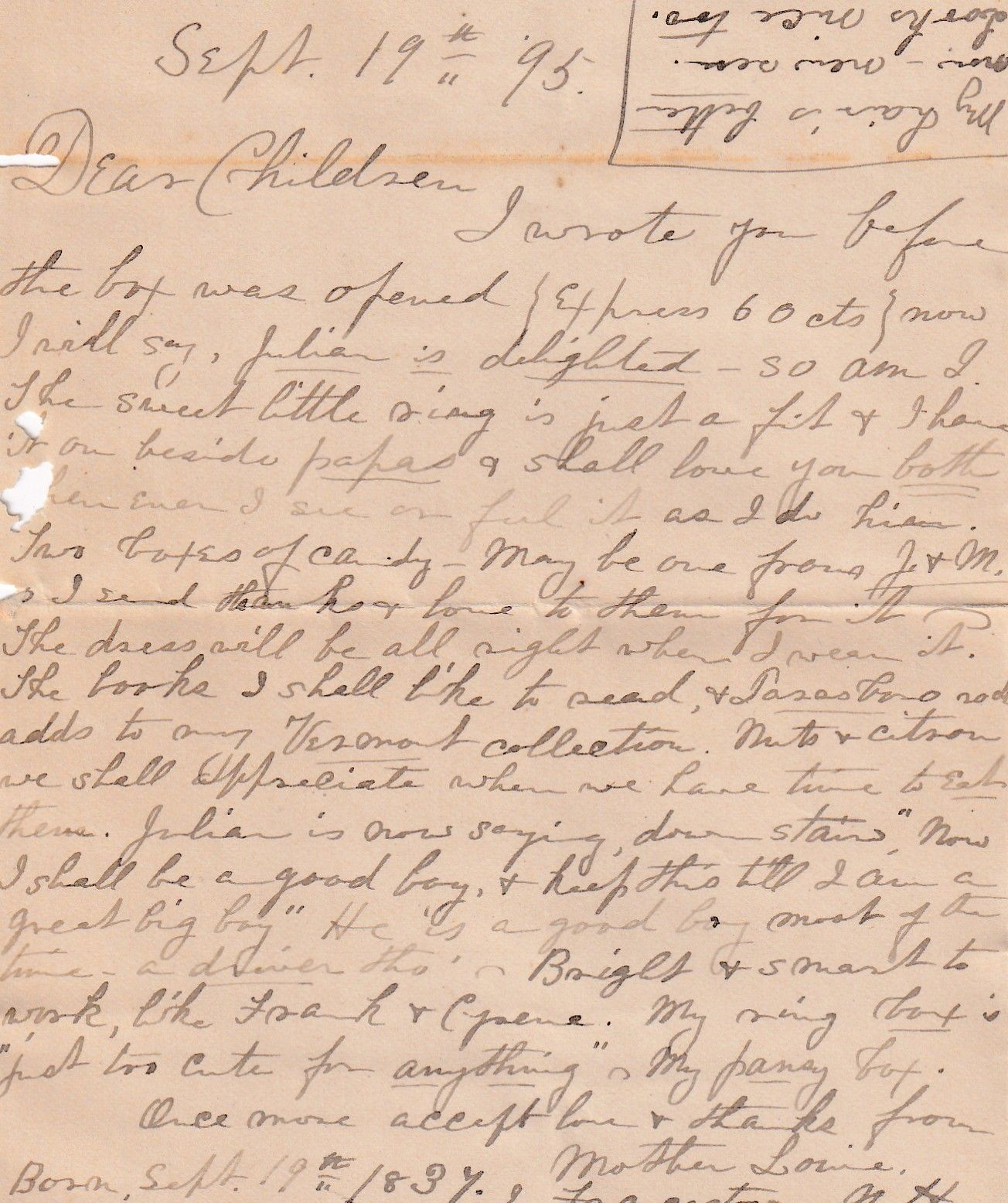
A handwritten letter from “Mother Louie” to her children dated September 19, 1895, expressing gratitude for gifts, sharing updates about family members, and reflecting warmly on domestic life and relationships.
RE-LE-1895-0054
Family correspondence, gratitude, and domestic updates
Massachusetts
North America
Personal Correspondence Letters
Sep 19, 1895
Victorian
(Modernized, readable transcription; minor reconstruction where needed) Dear Children, I wrote you before the box was opened (Express 60 cts), and I will say Julia is delighted — so am I. The sweet little ring is such a fit, and I have it on beside papa’s, and shall love you both ever more I see or feel it, as I do him. Two boxes of candy may be one from J. & M. I send their love to them for it. The dress will be all right when I wear it. The books I shall like to read — “Zarastro” now adds to my Vermont collection. Motto & citrons we shall appreciate when we have time to eat them. Julia is ours, saying downstairs, “Now I shall be a good boy & help the little ones. I am a great big boy.” He is a good boy most of the time — a driver too; bright & smart to work, like Frank & Cyrena. My ring that is just too cute for anything — my fancy not. Once more accept love & thanks from Mother Louie Boston, Sept. 19th, 1895
English
Handwriting Style / Script Type Late Victorian cursive, Spencerian-influenced personal hand — fluid, expressive script with emotional emphasis through underlining and phrasing; moderately formal but intimate in tone Document Material Wove paper (machine-made), typical late 19th-century stationery — smooth surface with light aging; likely part of a folded letter sheet used for personal correspondence
This letter highlights the importance of gift exchange within family networks during the Victorian era, reinforcing emotional bonds across distance. Items such as rings, clothing, books, and sweets reflect both material culture and affection. The reference to wearing a ring alongside the deceased father’s ring suggests the intertwining of memory and daily life. The tone conveys warmth, gratitude, and continuity of family identity, even after loss. Mentions of children’s behavior and household roles illustrate expectations placed on youth within family structures.
Historical Note
Written in Boston in 1895, this letter reflects the urban domestic life of the late Victorian period. The mention of express shipping (“Express 60 cts”) indicates the use of established commercial delivery systems alongside the postal service. References to books, confections, and clothing provide insight into consumer goods available to middle-class families at the time. The continued mention of the deceased father across multiple letters reinforces the cultural importance of remembrance and mourning in Victorian society.