
08 – 10.3.23 Music, Performances, and Affection – Haleyville Letter
Letter
A lively and affectionate letter describing school performances, social events, and community gatherings, culminating in a candid emotional expression of attachment to the recipient.
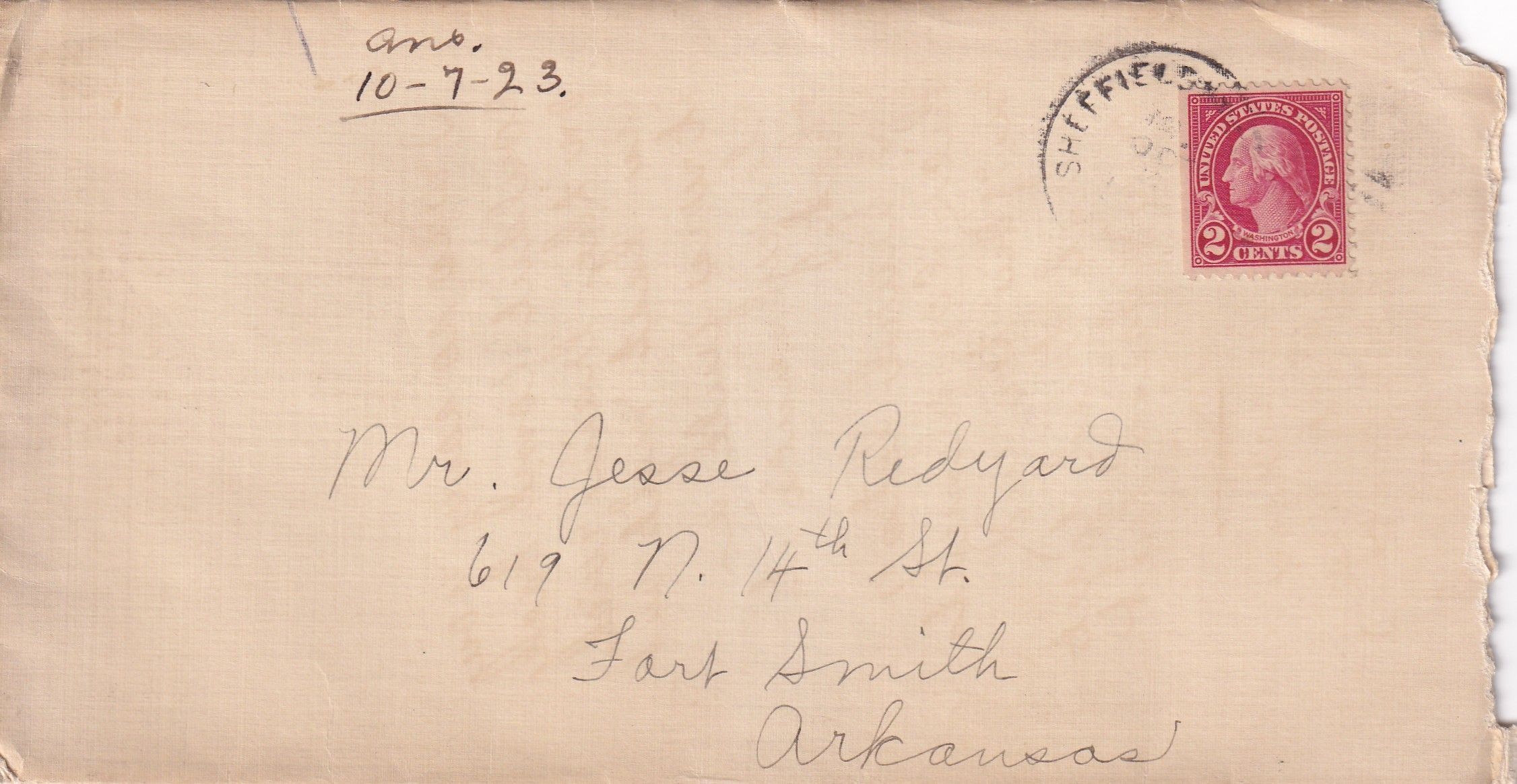 08 – 10.3.23 Music, Performances, and Affection – Haleyville Letter
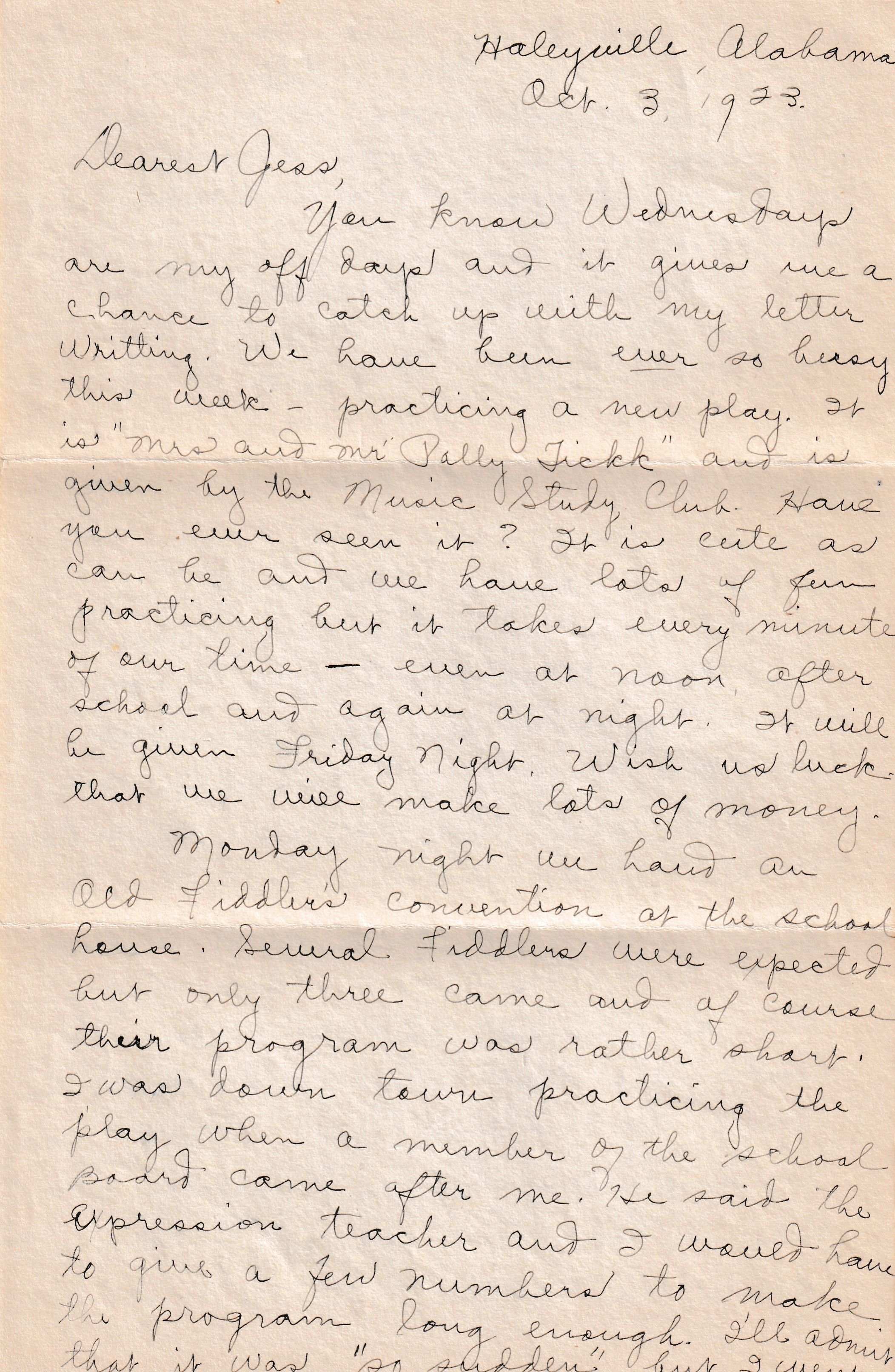 08 – 10.3.23 Music, Performances, and Affection – Haleyville Letter – Image 2
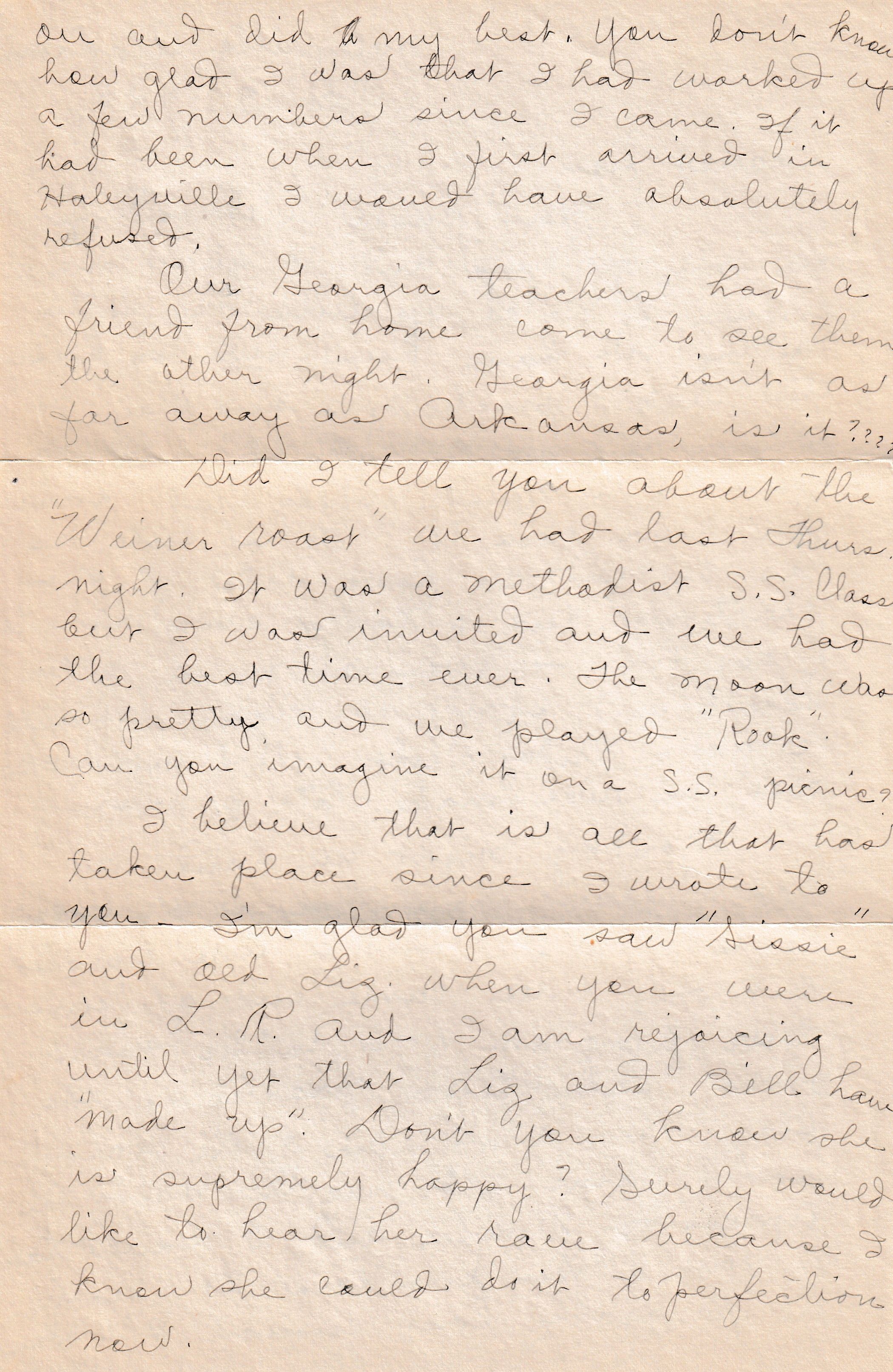 08 – 10.3.23 Music, Performances, and Affection – Haleyville Letter – Image 3
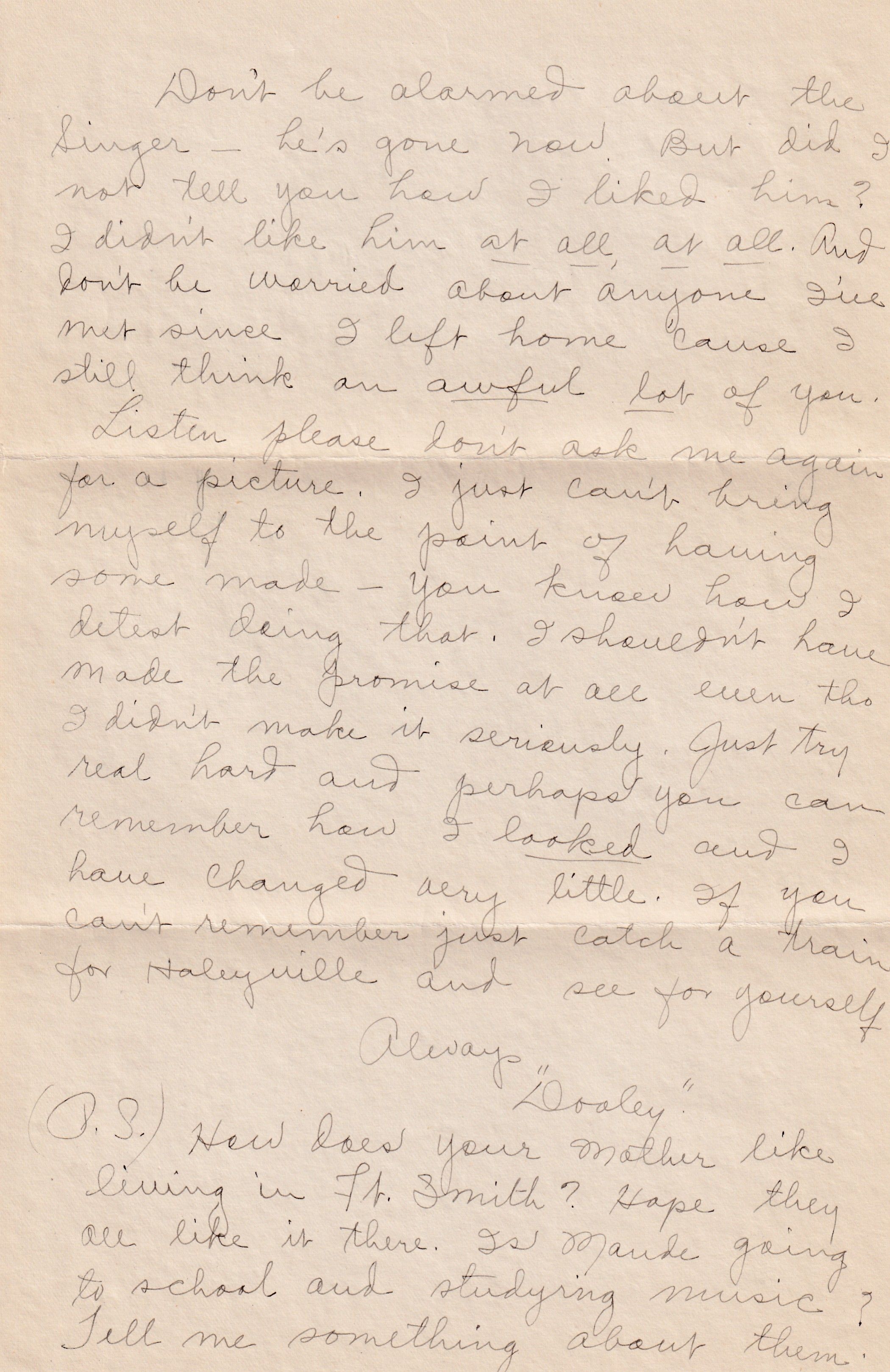 08 – 10.3.23 Music, Performances, and Affection – Haleyville Letter – Image 4
RE-LE-COLLHE-0054
Personal correspondence; music and performance; social life; romantic affection; teaching life
Alabama
Arkansas
United States
North America
Love & Courtship
Oct 3, 1923
20th Century
Haleyville, Alabama Oct. 3, 1923 Dearest Jess, You know Wednesdays are my off days and it gives me a chance to catch up with my letter writing. We have been ever so busy this week — practicing a new play. It is “Mrs and Mr Jolly Jacks” and is given by the Music Study Club. Have you ever seen it? It is cute as can be and we have lots of fun practicing but it takes every minute of our time — even at noon, after school and again at night. It will be given Friday night. Wish us luck that we will make lots of money. Monday night we had an Old Fiddlers’ Convention at the school house. Several fiddlers were expected but only three came and of course their program was rather short. I was down town practicing the play when a member of the school board came after me. He said the expression teacher and I would have to give a few numbers to make the program long enough. I’ll admit that it was “sudden” but I went on and did my best. You don’t know how glad I was that I had worked up a few numbers since I came. If it had been when I first arrived in Haleyville I would have absolutely refused. Our Georgia teachers had a friend from home come to see them the other night. Georgia isn’t as far away as Arkansas, is it??? Did I tell you about the “Weiner roast” we had last Thursday night. It was a Methodist S.S. class but I was invited and we had the best time ever. The moon was so pretty, and we played “Rook”. Can you imagine it on a S.S. picnic? I believe that is all that has taken place since I wrote to you. I’m glad you saw “Fierie” and old Liz when you were in L.R. and I am repairing until yet that Liz and Bill have “made up”. Don’t you know she is supremely happy? Surely would like to hear her rave because I know she could do it to perfection now. Don’t be alarmed about the singer — he’s gone now. But did I not tell you how I liked him? I didn’t like him at all, at all. And don’t be worried about anyone I’ve met since I left home cause I still think an awful lot of you. Listen please don’t ask me again for a picture. I just can’t bring myself to the point of having some made — you know how I detest doing that. I shouldn’t have made the promise at all even tho I didn’t make it seriously. Just try real hard and perhaps you can remember how I looked and I have changed very little. If you can’t remember just catch a train for Haleyville and see for yourself. Always, “Dooley” P.S. How does your mother like living in Ft. Smith? Hope they all like it there. Is Maude going to school and studying music? Tell me something about them.
English
This letter is especially revealing of the writer’s personality: Confident and socially active (performing, organizing, teaching) Playful and teasing (about distance, friends, and events) Emotionally direct but guarded: → Openly reassures Jess of her feelings → Refuses to send a photograph (suggests modesty or self-consciousness) The line: “I still think an awful lot of you.” is a clear, sincere emotional anchor—marking this as a courtship-stage relationship.
Historical Note
This letter offers a vivid look at small-town cultural life and emotional expression in the 1920s: Community Entertainment: Events like: → School plays → Old Fiddlers’ Conventions → Church picnics (“weiner roast”) demonstrate how entertainment was locally produced and participatory Music & Performance Culture: The writer’s role in: → Music Study Club productions → Filling in performances spontaneously shows the importance of multi-talented educators in rural communities Religious-Social Overlap: Methodist Sunday School events doubled as: → Social gatherings → Courtship spaces → Recreational activities Card Games & Leisure: “Rook” was a very popular card game in Protestant communities (preferred over traditional playing cards) Mobility & Distance Awareness: The comparison between Georgia and Arkansas reflects: → Perception of distance in the early automobile/rail era → Emotional geography of relationships