
1909.2.1 – The Melwyn, Astoria, Oregon
Letter
A personal letter written from Astoria, Oregon, describing travel from Portland, impressions of the coastal environment, and business activity, with vivid observations of the town’s waterfront construction and climate.
RE-LE-COLLBER-55
Travel, business, and personal correspondence
Oregon
United States
Travel Correspondence
Business & Legal Documents
Personal Correspondence Letters
Feb 1, 1909
20th Century
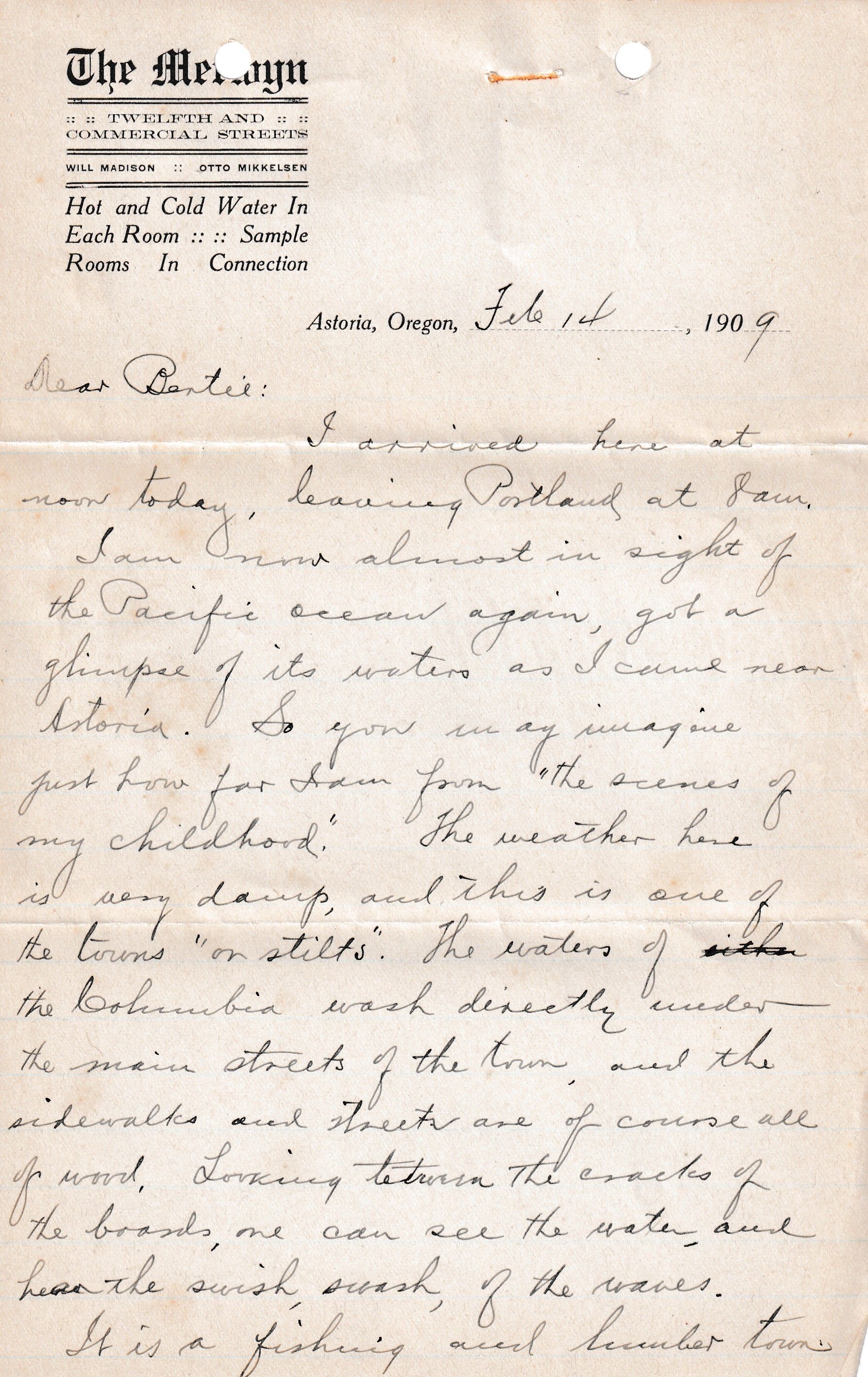
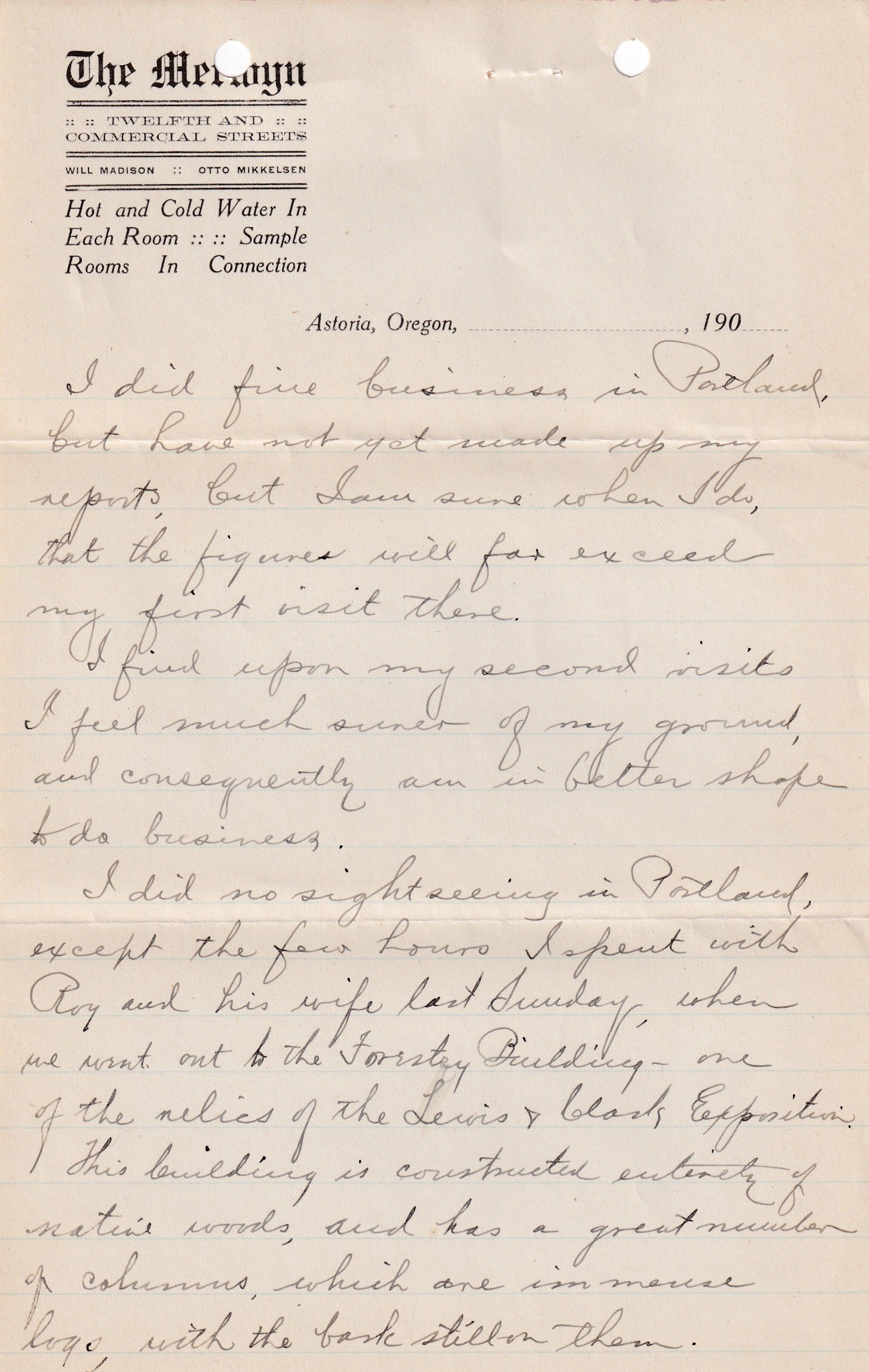
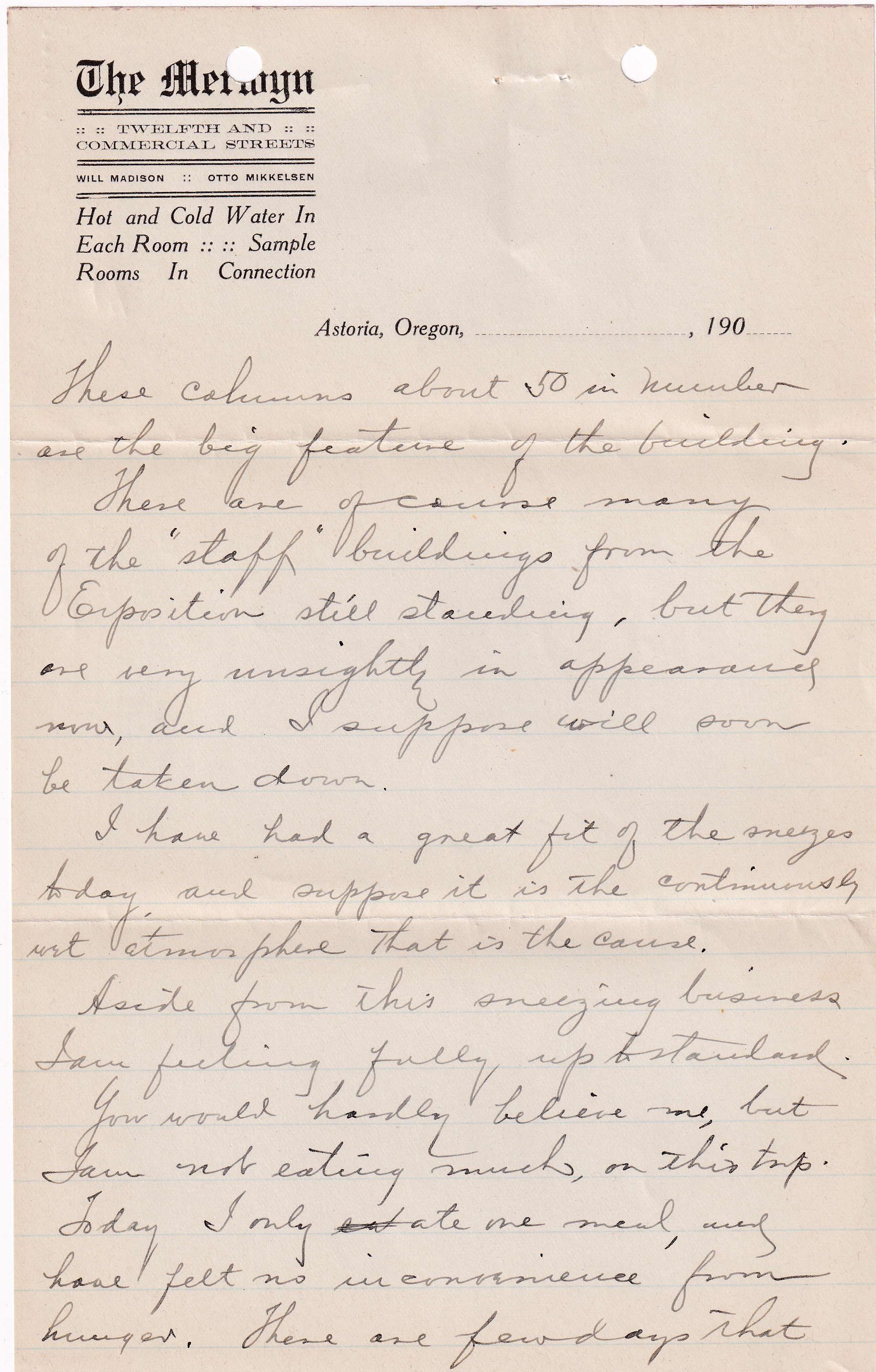
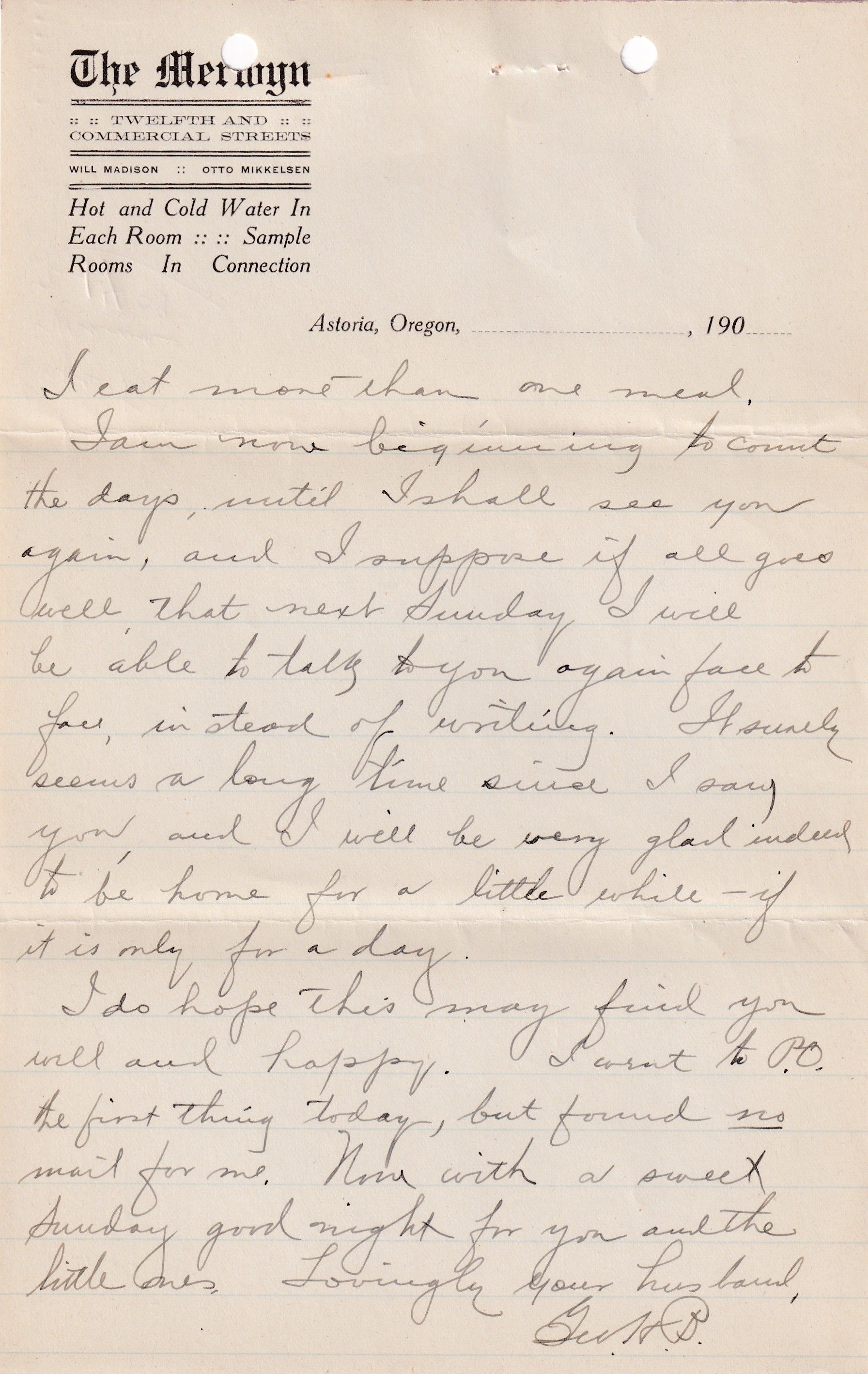
Dear Bertiee: I arrived here at noon today, leaving Portland at 8 a.m. I am now almost in sight of the Pacific Ocean again, got a glimpse of its waters as I came near Astoria. So you may imagine just how far I am from “the scenes of my childhood.” The weather here is very damp, and this is one of the towns “on stilts.” The waters of the Columbia wash directly under the main streets of the town, and the sidewalks and streets are of course all of wood, looking between the cracks of the boards, one can see the water and hear the swish, swash of the waves. It is a fishing and lumber town. I did fine business in Portland, but have not yet made up my reports, but I am sure when I do, that the figures will far exceed my first visit there. I find upon my second visits I feel much surer of my ground, and consequently am in better shape to do business. I did no sightseeing in Portland, except the few hours I spent with Roy and his wife last Sunday, when we went out to the Forestry Building, one of the relics of the Lewis & Clark Exposition. This building is constructed entirely of native woods, and has a great number of columns, which are immense logs, with the bark still on them. These columns about 50 in number are the big feature of the building. There are of course many of the “staff” buildings from the Exposition still standing, but they are very unsightly in appearance now, and I suppose will soon be taken down. I have had a great fit of the sneezes today and suppose it is the continuously wet atmosphere that is the cause. Aside from this sneezing business I am feeling fully up to standard. You would hardly believe me, but I am not eating much on this trip. Today I only ate one meal and have felt no inconvenience from hunger. There are few days that I eat more than one meal. I am now beginning to count the days until I shall see you again, and I suppose if all goes well, that next Sunday I will be able to talk to you again face to face, instead of writing. It surely seems a long time since I saw you, and I will be very glad indeed to be home for a little while—if it is only for a day. I do hope this may find you well and happy. I went to P.O. the first thing today, but found no mail for me. Now with a sweet Sunday good night for you and the little ones. Lovingly your husband, Geo. W.D.
English
This letter reflects early 20th-century American business travel culture, where men frequently traveled alone for extended periods, maintaining family relationships through written correspondence. The tone is affectionate but restrained, typical of middle-class marital communication of the era. The writer’s observations emphasize industrial and environmental realities: Astoria is described as a working town—“fishing and lumber”—rather than a leisure destination. His fascination with the town “on stilts” highlights how unfamiliar coastal infrastructure appeared to inland travelers. His eating habits (one meal per day while traveling) may reflect: Time constraints of business travel Personal discipline or financial prudence Common travel discomforts of the era The mention of the Forestry Building and exposition remnants reveals a culture still shaped by World’s Fair exhibitions, which served as major civic and economic showcases.
Historical Note
🏨 Hotel Information The Melwyn (Astoria, Oregon) Name: The Melwyn Location: Twelfth and Commercial Streets, Astoria, Oregon Managers: Will Madison & Otto Mikkelsen Features advertised: “Hot and Cold Water in Each Room” Sample rooms (indicating accommodation for traveling salesmen) Context: The Melwyn was a commercial hotel, catering primarily to traveling businessmen—exactly matching the writer’s situation. Its advertised amenities reflect a transitional period in hotel standards, where in-room running water was still a notable luxury. Astoria at this time was a major Pacific Northwest port city, strategically located at the mouth of the Columbia River. Hotels like The Melwyn were essential infrastructure for: Timber and fishing industries River and maritime trade Traveling salesmen and regional commerce It is unclear whether The Melwyn building still exists under that name today; many structures in Astoria have been rebuilt or repurposed following fires and redevelopment in the 20th century. 🌊 Astoria “Town on Stilts” The writer’s description is historically accurate: Large portions of Astoria were built on pilings over tidal flats Streets and sidewalks were often wooden planks The Columbia River flowed beneath parts of the town This construction method was common in Pacific Northwest port towns due to: Tidal fluctuations Marshy terrain Rapid industrial expansion 🌲 Lewis & Clark Exposition (1905) The letter references the Forestry Building, a major attraction from the exposition: Held in Portland in 1905 Celebrated regional industry and westward expansion The Forestry Building was famous for being constructed entirely from massive logs with bark intact By 1909, as noted in the letter: Many temporary “staff” buildings remained They were already deteriorating and considered unsightly