
11 Bodice, Shirts, Skirts, Dresses & Capes 1850-1925
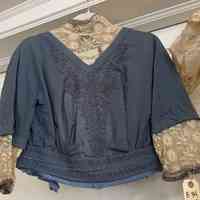
Bodice (Decorative Day Bodice)
This short-waisted bodice exemplifies the decorative surface treatment characteristic of the late Edwardian period, just prior to the simplification of dress brought on by World War I. Constructed in a muted slate-blue textile—likely a fine wool or sturdy cotton twill—the garment features a softly bloused waist and abbreviated sleeves that suggest wear over a separate lace underbodice or guimpe.
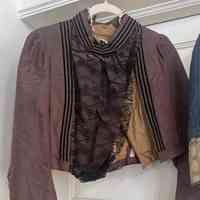
Bodice (Evening or Visiting Bodice)
This tailored bodice exemplifies the refined yet transitional silhouette of the late Victorian and early Edwardian period. Constructed of mauve-plum silk taffeta, the garment features a fitted waist and softly gathered sleeves set into the shoulder, creating the characteristic fullness fashionable around the turn of the twentieth century. The sleeves taper toward the wrist and are finished with narrow applied velvet ribbon bands and a modest pleated cuff.
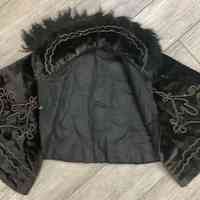
Decorative Cape / Mantle
This richly ornamented Victorian mantle exemplifies the decorative outerwear fashionable in the late nineteenth century, when capes and mantles served both functional and aesthetic roles in women’s dress. Cut in a short, flared form, the garment is designed to rest over the shoulders and upper arms, complementing the fitted bodices and structured skirts of the period.
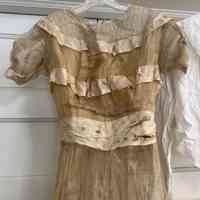
Edwardian Sheer Silk Lingerie Dress
A sheer, pale ivory silk gauze lingerie dress composed of a fitted bodice and lightly flared skirt, constructed for wear over a corseted foundation. The bodice features a broad lace yoke panel across the shoulders and upper chest, executed in machine-made cotton lace typical of the early twentieth century. Short, softly gathered sleeves of transparent silk terminate above the elbow. Horizontal bands of bias-cut silk ribbon trim articulate the bodice and waist, forming a structured visual emphasis at the midsection. A wide ribbon waistband encircles the waist, originally providing both decorative contrast and structural reinforcement. The skirt falls in a gentle A-line, maintaining the vertical softness characteristic of the Edwardian silhouette. Decorative applied trim in the form of small leaf-like elements appears along the lower skirt band, further emphasizing the garment’s light, romantic aesthetic. The interior reveals a fitted cotton waistband, confirming proper period construction and intended wear over supportive undergarments.
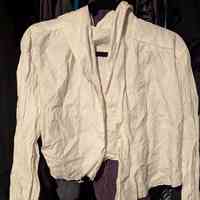
Edwardian White Cotton Shirtwaist Blouse
A white cotton Edwardian shirtwaist featuring long sleeves, plain cuffs, a soft fold-over collar, front button closure, and delicate insertion stitching along shoulder seams. Circa 1900–1915.
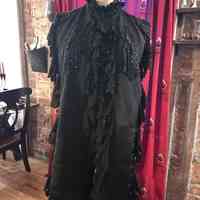
Late Victorian Black Beaded Mourning Capelet (Shoulder Cape)
Elegant late Victorian shoulder cape of black silk richly ornamented with jet beadwork, black lace ruffles, beaded fringe, and a standing ruffled collar. Designed to drape over the shoulders while leaving the front open, the capelet would have been worn over a fashionable bodice or dress for formal, evening, or mourning attire.
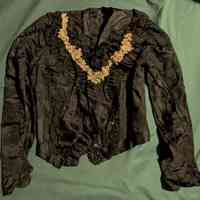
Late Victorian women’s bodice
This is a late Victorian women’s bodice, most likely dating to c. 1895–1905, designed to be worn as part of a structured outfit (skirt worn separately). It sits right at the transition from true Victorian into early Edwardian styling.
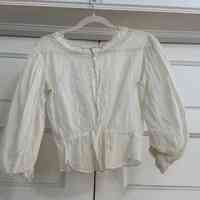
Lingerie Blouse (White Lawn Blouse with Lace Trim)
This white lingerie blouse exemplifies the delicate, light-filled aesthetic of the high Edwardian period. Constructed in a fine semi-sheer cotton lawn or possibly lightweight linen, the garment features a softly bloused waist, rounded neckline, vertical pintuck decoration, and voluminous sleeves gathered into lace-trimmed cuffs. The neckline is finished with a wide band of lace insertion, forming a shallow scooped collar. The lace appears machine-made, likely cotton, with repeating geometric and floral motifs typical of commercial Edwardian lace. The sleeves are full and softly gathered, creating a romantic silhouette associated with 1905–1912 fashions.
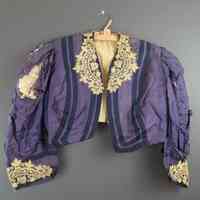
Purple Silk Evening Bodice with Ecru Lace Appliqué
A cropped purple silk bodice featuring applied ecru floral lace at the neckline and cuffs, dark blue woven trim bands, and voluminous sleeves. Likely intended as an evening or semi-formal bodice worn over a coordinating skirt. The garment reflects late Victorian decorative taste emphasizing surface embellishment and structured shaping.
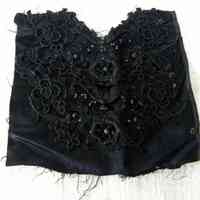
Textile Fragment – Beaded Appliqué Bodice Panel
Rectangular silk satin fragment (approx. 7–8 inches in height based on tape reference), originally cut in a shallow V configuration at the upper edge, suggesting it formed the center front of a bodice. The ground fabric appears to be black silk satin, now softened and slightly dulled with age. The lower edge is raw and frayed, indicating removal from a larger garment. The surface is densely decorated with: Raised corded floral motifs (soutache-style looping cord) Dimensional rosette forms at center Faceted jet or jet-glass beads Small round seed beads Layered floral appliqué construction The design is symmetrical and vertically oriented — typical of center-front bodice ornamentation.
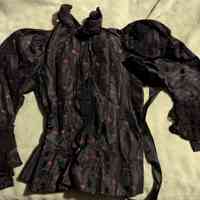
Victorian Revival Bodice
Victorian Revival / Edwardian Fantasy
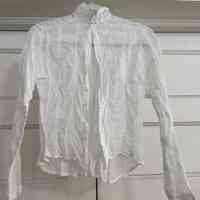
White Shirtwaist / Lingerie Blouse
This lightweight white blouse represents the emergence of the tailored “shirtwaist” and lingerie blouse that became foundational to women’s dress at the turn of the twentieth century. Unlike heavily structured Victorian bodices, this garment is soft, washable, and designed to be worn separately from a skirt. The silhouette suggests wear over a corset and likely tucked into a gored skirt. The slight flare at the lower hem indicates it may have been worn loosely over the waistband rather than tightly fitted.
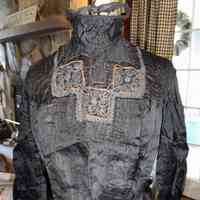
Woman's Black Silk Bodice with Soutache Embroidery
Elegant late Victorian black silk bodice featuring an embroidered soutache yoke, standing collar with gathered chiffon trim, fitted cuirass silhouette, and hand-finished interior construction. Designed for formal afternoon or evening wear, the bodice reflects the refined tailoring and decorative surface embellishment popular during the late 1880s.
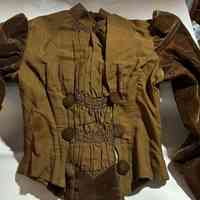
Woman's Brown Wool and Velvet Bodice (Six-Button Front)
Fashionable late Victorian fitted bodice constructed of brown wool with luxurious silk velvet sleeves, decorative shirred front panel, and six oversized velvet-covered buttons. Designed to be worn over a corset with a matching skirt, the bodice represents the tailored daywear popular during the mid-1890s.
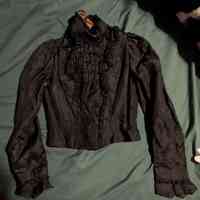
Woman’s Bodice / Corset-Bodice Hybrid
Woman’s Bodice / Corset-Bodice Hybrid c. 1878–1886 (Late Victorian, Natural Form / Early Bustle Era)
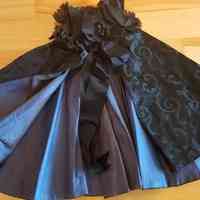
Woman’s Evening Cape (Mantle)
This Victorian mantle is a short, structured shoulder cape designed to be worn over a fitted bodice, characteristic of late 19th-century outerwear intended for formal or semi-formal use. The garment combines contrasting silk textiles, complex pleating, and decorative neck treatment, reflecting the period’s emphasis on layered texture and controlled volume.